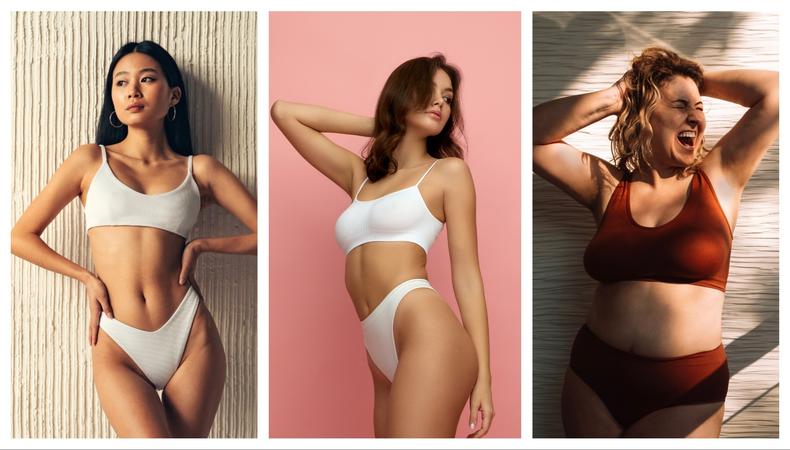
Pear, hourglass, or ironing board? The industry has used all kinds of terms to describe bodies, but thankfully it’s progressed over the last 20 years. Today there are more body types needed than ever before, with size, ability, age, and race all more inclusive.
The so-called perfect model body is an elusive ideal, and ultimately depends on what type of modelling you want to do – and what the brand or designer is after. Since there are so many modelling niches, there are different types of models with a range of typical measurements.
That means there are castings to fit every mold.
So, where does your body fit in?
JUMP TO
A look at Models.com's Top 50 models gives an idea of today’s most in-demand body types for modelling. They’re judged based on the number and quality of cover shoots, campaigns, and editorial work they have appeared in, as well as their social media presence. At the time of writing, all are female, more than half are white, about one-third are Black, and three are plus-size.
From a measurements’ point of view, more than three-quarters of the women on this list are 5’9” or taller, have a 25” waist, 35” hips, and a 32” or smaller bust.
While this is by no means an exhaustive list, it gives an idea of which body types are preferred by the top photographers, brands, and casting directors.
It’s worth noting that this list skews younger, with most of its models aged 25 or under, since it focuses on models who are on the rise, rather than established icons.
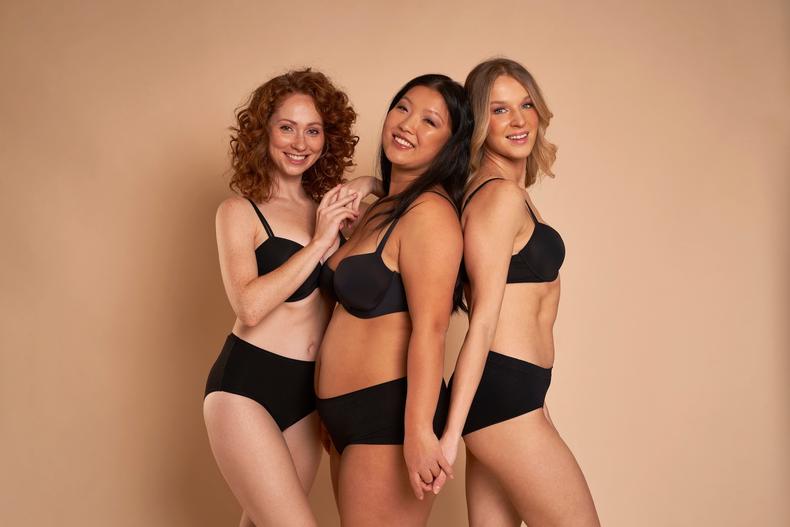
gpointstudio/Shutterstock
The biggest change in the past 20 years has been an increase in diversity.
Casting director Troy Fearn told Dazed in 2019: “When starting out, ‘diversity’ and ‘inclusivity’ were very much buzzwords with brands often, and sometimes quite obviously, casting one non-white model in order to tick the POC [person of colour] box. The industry…is so much more open to diversity and positive representation than it has ever been.”
That diversity extends to size as well. Since 2000, there has been a rise in plus-size dedicated agencies, like Icon Management (formerly Bella) in Australia and Milk Management, the UK’s first plus-size agency, started by trailblazing curve model Anna Shillinglaw in 2011. The latter was recently rebranded The Milk Collective.
Pioneering designer brands like Sinéad O’Dwyer have broken the mould by creating multiple sample sizes and broadening the body types in their runway shows.
More agencies have started taking on curve and plus-size models too. IMG opened a plus-size division for men called Brawn in 2016.
What’s more, models with disabilities or models with unique conditions have increasingly secured some of the most enviable jobs in the business. In 2018 Winnie Harlow was the first model with vitiligo to walk the Victoria’s Secret runway. Aaron Philip, who uses a wheelchair, became the face of Moschino’s Fall 2020 campaign. And Ellie Goldstein was the first model with Down syndrome to appear on the cover of British Vogue in 2023.
So, while there may still be a generic modelling body type, there is increasingly room for diversity and inclusion in the world of fashion.
Catwalk
While a small percentage of catwalk models have been plus-size in recent years, the dominant body for modelling is UK size 8 (US size 4) or smaller. According to designer Tom Ford, the reason is that the runway showcases your sample collection, and every sample collection is made in the same size.
“This is an industry thing,” he told WWD. “Whether we all decide to start making all of our clothes in the next size up, that’s a different thing. But there is practicality, there’s a reason models are a standard size.”
So, until there is a shift in what the industry decides to be “standard size,” catwalk models will remain size 8 or smaller.
Plus-size
Plus-size and curve still aren’t precisely defined, with brands having various expectations. Often the models you see in plus-size sponsorships, e-commerce photography, and lookbooks are between a UK 12 and 18.
In 2020, Jill Kortleve, a size 10, was celebrated for being the first plus-size model on the Chanel runway in a decade. But according to Shillinglaw, the most successful curve models are “a really great size 16…with a waist, boobs, and a butt. Brands tell me the hourglass figure is what sells the best.”
Increasingly, bigger sizes are needed, with brands like Torrid, Girlfriend Collective, Wray NYC, and Universal Standard hiring sizes UK 20 and beyond.
Commercial
For commercial work, such as campaigns and catalogues, body types typically vary. Since brands want models to represent their customers, it means opportunities for a diverse range.
On the one hand, there has been a notable increase in demand for models who are larger than a size 8. Fashion bookings director Megan McCluskie told The Telegraph: “I'm finding a lot of my clients ask for curve models, and I include them as standard in any casting proposals I make for editorials.”
On the other hand, many campaigns still use those tiny standard sample sizes.
So, the most in-demand body types depend on the brand and how forward-thinking its creative directors are. However, pressure from social media, the body positive movement, and everywhere from Vogue to the Daily Mail means that big brands are redefining what a “perfect” body might look like.