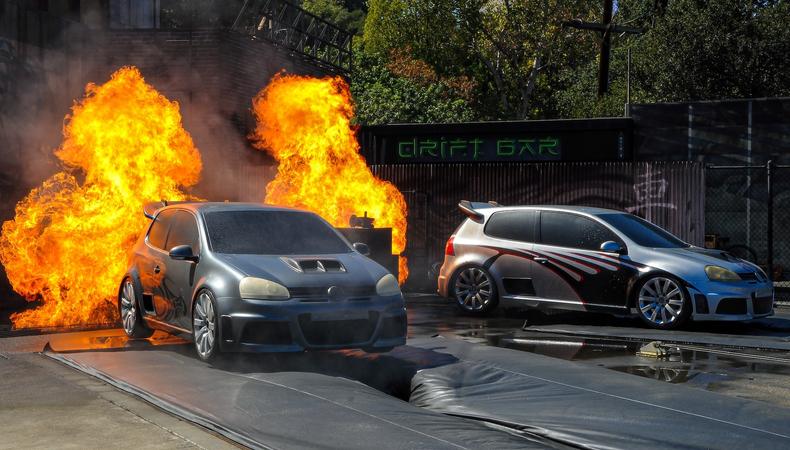
Jumping from buildings, crashing cars, fighting villains, and taking spectacular falls for the movies – the heart-pounding life of a stunt performer sounds like a nonstop adrenaline ride.
But becoming a stunt double is about much more than being brave, athletic, or willing to throw yourself down a flight of stairs. Stunt performers are highly trained physical artists who work within a tightly regulated industry with safety, preparation, and professionalism at the heart of the job.
For aspiring actors, stunt work can also open up another route into film and television – and give you skills that can make you more versatile onscreen.
Are you an aspiring stunt double? Here’s what you need to know to get started.
JUMP TO
A stunt double is a performer who replaces an actor for hazardous or highly physical action in a film or television production. As professional stunt actor Haydn Dalton explains, there is a distinction between a stunt performer and a stunt double. A stunt performer may play a generic character performing a stunt – such as a soldier being thrown by an explosion – while a stunt double performs that action in place of a specific actor.
“A stunt double would be doing stunts for one of the lead actors on the show, replacing them for hazardous action,” Dalton says.
That can mean anything from fights, falls, and car crashes to horse riding, swimming, and acrobatic wire work.
The job isn’t necessarily limited to the biggest set pieces either. A stunt double may spend much of a production standing in for an actor during physically demanding scenes, while other stunt performers work as featured characters or in background action.
There is also an important difference between a body double and a stunt double. A body double is generally used when a production needs someone who physically resembles an actor for a shot, while a stunt double specifically performs action that the actor isn’t performing themselves.
Resemblance is important for a stunt double, but it isn’t necessarily about looking identical. Dalton says height, build, and movement are often more important, and specialist hair, makeup, and costuming help to complete the illusion.
The relationship between actors and stunt doubles is also highly collaborative. Doubles need to study how the actor moves and reproduce their physicality convincingly while maintaining a professional relationship with the person whose performance they are helping to create.
There isn’t one set course or qualification that will turn you into a stunt double. Becoming a professional stunt performer involves building a broad set of physical skills, gaining experience, and working through Australia’s stunt grading system.
Your starting point may be acting, martial arts, dance, gymnastics, circus, climbing, diving, driving, or another movement-based discipline. What matters is gradually developing the skills and professional experience required to work safely on a film or television set.
With that in mind, here’s a five-step plan to follow.
1. Find your physical discipline.
You don’t need to arrive with a background in stunts. Many performers come to the industry through another discipline.
For Adelaide-based actor and action choreographer Ruth Fallon, becoming “a big martial arts nerd” is what drove her down the path of stunt work.
She trained in dance and calisthenics before studying drama and going on to spend five years predominantly working in children’s television. Her interest in physical performance led her to train with martial arts master and stunt trainer Nino Pilla.
“I fell in love with acting and then martial arts, and then through the martial arts, I started meeting a lot of people who were stunt graded and started working in the stunt industry,” Fallon says.
For a beginner, the first step may be as simple as finding a discipline that develops body awareness, coordination, and physical control. Martial arts, gymnastics, dance, and other movement practices can all provide useful foundations.
2. Build a broad stunt skill set.
Once you’ve developed a physical foundation, you can start adding the disciplines required of professional stunt performers.
The Australian grading system covers several areas, including body control, heights, vehicles, animals, and water. Fallon recommends starting with body control before gradually adding areas such as swimming, driving, heights, and climbing. As part of her own pathway, she gained her swimming qualification, undertook driving courses and heights training, and progressed into rock climbing.
You don’t necessarily have to master every discipline to the same level. Instead, think about building a versatile toolkit while developing particular areas of expertise.
Additional qualifications and skills can also make you more employable. Dalton points to skills such as motorbike riding, scuba diving, surfing, and stunt rigging as examples of abilities that can help performers stand out when coordinators are looking for someone with a particular skill.
The exact combination of skills will depend on the person, which is why there isn’t one universal route into the profession.
3. Work toward stunt grading.
If your goal is to work professionally as a stunt performer in Australian film and television, you’ll need to understand the industry’s grading system.
The Media, Entertainment, and Arts Alliance (MEAA) oversees the national stunt grading procedure through its National Stunt Committee. Rather than simply completing a single stunt course, applicants build up training, experience, and professional sign-offs across the relevant disciplines.
Fallon describes the process as a substantial commitment. Candidates need to accumulate training and hours in different areas, and have their skills signed off on by qualified professionals. She says it can take a couple of years to build up the necessary experience.
The entry level is Stunt Actor Provisional (SAP), after which performers can progress through higher levels of grading. The pathway can eventually lead toward roles including stunt performer, assistant stunt coordinator, and stunt coordinator.
Importantly, grading isn’t about proving that you can perform the most dangerous stunt. It’s about demonstrating that you have the skills, experience, and control required to perform safely and professionally.
4. Train with the right people.
There isn’t necessarily one institution where you’ll complete every element of your stunt training. Fallon trained predominantly in Adelaide but travelled interstate for some specialist training. She says that is common for people working toward stunt grading. Access to training can be easier in larger production hubs such as Sydney, Melbourne, and areas of Queensland, but performers outside those locations can build networks and travel when necessary.
That’s where researching reputable stunt professionals and training facilities becomes important. Rather than looking for a single stunt school, aspiring performers may need to build a training programme across several disciplines and instructors.
Before signing up for a course, make sure you understand what it teaches, who is teaching it, and whether it contributes to the skills and experience required for professional stunt grading.
5. Get to know the industry.
Training is only part of becoming a stunt double. Like acting, stunt work is a professional network-based industry, and building relationships with experienced performers and stunt coordinators is important.
Dalton’s own career illustrates how opportunities can arise through those professional connections. Since he started in the industry in 1994, he has doubled for respected Australian actors including Anthony LaPaglia and Daniel Henshall, and he also spent years doubling for Hollywood actor Zach Galifianakis, including in The Hangover films. The latter came his way when an American stunt coordinator was looking to hire Australian performers for The Hangover Part II, which was shot in Thailand.
Dalton also founded Stunt Book Australia, a directory where professional stunt performers can showcase their professional profiles and book work. For someone starting out, browsing showreels on the website can be useful for understanding the range of skills stunt people must develop and the different routes their careers can take.
The following Australian training options are recommended as starting points for aspiring performers.
- Stunt Gym (NSW): A Sydney-based facility that offers training in physical movement, parkour, and free-running.
- Stunt Action Consultants (NSW): A versatile business based in Sydney that provides world-class stunt training amongst a range of stunt services.
- Stunt Academy (QLD): Based out of Stunt Park on the Gold Coast, this facility offers introductory classes, professional stunt courses, and specialist training in areas including falls, high falls, wire work, and fight choreography.
- Stunt HQ (QLD): A Gold Coast–based stunt training facility that offers programmes designed around the Australian grading pathway, as well as training in areas including driving, fire, heights, and combat.
- DNA Stunts (QLD): A Southport-based stunt training option that offers classes for beginners led by experienced stunties.
- Stunt City (VIC): This Melbourne-based training facility is run by experienced stunt actor and assistant stunt coordinator Matthew Campbell (aka Chippa).
- Nino Pilla International Academy of Martial Arts (SA): Adelaide-based Nino Pilla has been teaching martial arts for over 40 years, training countless martial artists and actors.
- Individual trainers in Victoria: Dalton specifically recommends researching training opportunities with Melbourne-based stunt professionals Matthew Campbell and Philli Anderson.
You can also refer to Fight Creative for a curated guide to Australia’s stunt academies, training facilities, screen-fighting and stunt-driving schools, and equestrian stunt teams.
Remember: Professional stunt work is about managing risk, not seeking it out. Whatever course you choose, the aim isn’t simply to learn how to perform spectacular-looking tricks. You’re building the skills and professional experience required for a career in a safety-critical environment.
A career as a stunt performer doesn’t necessarily end with stunt doubling. Some performers may alternate between working as a stunt double and more generalist stunt roles, while others may strike up a working relationship with an action movie star and spend their career following them from project to project.
The Australian grading structure itself provides a pathway to more senior roles, such as stunt coordination. A stunt coordinator is responsible for designing and overseeing action, breaking down scripts, assessing risks, and managing stunt teams.
Other performers develop specialist careers in areas such as fight choreography, stunt rigging, precision driving, and action choreography.
Fallon’s stunt work has complemented her acting career rather than replaced it. She says gaining her stunt grading has also opened up opportunities to audition for action-oriented acting roles where she can perform her own fight choreography and stunts.
Fallon’s work as a fight choreographer also led her to become certified as an intimacy choreographer, working on productions for Amazon, Netflix, and the ABC, along with State Theatre Company of South Australia and State Opera South Australia. “Love and hate are two halves of the same coin,” she says.
Some aspiring actors find their way into stunt work because their ability to carry out stunts as well as act can make them versatile performers, but it’s possible to travel in the opposite direction too.
Fallon stresses that careers in the arts rarely follow a linear path, and performers may move among acting, choreography, training, and stunt work over different stages of their careers. Dalton, too, has seen stunt doubles become actors.
Stunt training can be a way to expand your physical vocabulary, discover new performance disciplines, and become a more versatile performer.
Stunt work may look like an adrenaline-fuelled career, but professional stunt performers aren’t thrill-seekers simply throwing themselves into danger. The job is about understanding, controlling, and minimising risk.
That is one reason the pathway into professional stunt work is so rigorous. Aspiring performers need to develop a high level of body control and demonstrate competency across many disciplines before they can progress through Australia’s stunt grading system.
Fallon says performers need to have a strong understanding of the physical risk involved, as well as control of their bodies. Building those skills takes time, and candidates are expected to train extensively and have their abilities signed off on by professionals in the relevant disciplines.
Stunt work is physically demanding and carries inherent risks, so knowing your limits is just as important as knowing what your body can do. On a professional film set, stunts are carefully planned and coordinated rather than improvised for the sake of getting a bigger reaction.
Stunt work may be very cool, Dalton says, but “it’s still a job.” That means professionalism, preparation, and responsibility are essential.