
The Edinburgh Festival Fringe is the world’s biggest arts festival, taking over the Scottish capital for three weeks every August. Initially, it was – as the name suggests – a fringe event that happened around the Edinburgh International Festival (which also still runs each August), but since its first outing in 1947, the Fringe has grown substantially and now frequently hosts over 3,000 events. All sorts of buildings all around the city become venues, staging theatre, comedy, dance, and everything in between at almost any time of day or night.
The Fringe (as it’s often referred to) has long been a place where dreams are made – where hungry young artists get their breakout hit or make their name. The festival is seen as a hotbed of emerging talent, and theatre, TV, and film commissioners often attend to scout for the stars of tomorrow. Fleabag, Baby Reindeer, The League of Gentlemen, and Six all began at the Fringe. But it can also be an overwhelming and exhausting prospect for performers, and it’s increasingly expensive, with grumbles that the costs now outweigh the opportunities.
What should you know before doing the Fringe?
JUMP TO
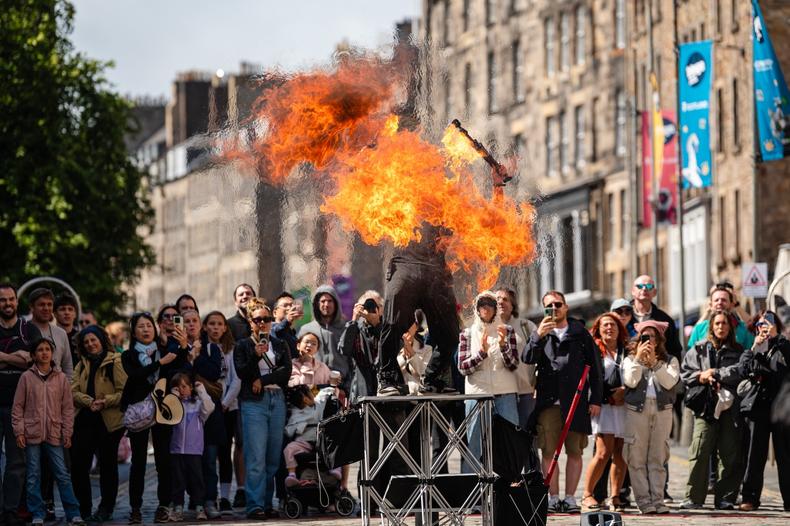
There are no hard-and-fast rules for what a Fringe show should be; you can find everything from extravagantly odd clowning to conventionally staged classics. But the Fringe still tends to be a place where playful, direct, experimental, scrappy storytelling work thrives, rather than immaculately polished, highly conventional productions. A clear hook or gimmick – three actors retell the whole of The Lord of the Rings or a time-travelling lesbian love story performed by opera-singing drag queens (both real examples) – can also be useful to help you cut through the noise, find an audience, and shift tickets.
Because each venue hosts multiple shows a day, a production needs to be able to get in and get out very quickly, so elaborate and expensive sets are rare. Many spaces are also small, so being fleet and flexible is wise. For similar reasons, a lot of work by emerging artists will have small casts or be a solo show – you’ll see many monologues in the programme.
There is also a well-established convention that Fringe shows are shorter; most clock in around an hour, and it’s very rare to have an interval. That is again due to budget constraints, but also to the packed schedules of visitors who want to watch multiple shows in a day. It also mimics the length of a comedy show, which rarely stretches past an hour.
“It’s very difficult to justify a show that’s over an hour long,” says Jessica Lazar, a director who got her break at Edinburgh in 2016 with Life According to Saki, and more recently had Fringe hits with Sap and Bellringers, in 2023 and 2024 respectively. “The audience become so used to things running at between 50 minutes and an hour that their internal clock is extraordinarily precise and people start to get shifty. You have to earn every single beat.”
Credit: Euan Cherry/Shutterstock
The Edinburgh Fringe Society has lots of information to help aspiring performers, including on finding a venue. Many shows will be hosted by the “big four” venues, which are actually companies that run different spaces across the city: Assembly, Gilded Balloon, Underbelly, and Pleasance. But a fifth complex, Summerhall, has for many years been a leading venue for interesting theatre, and other well-established options include Zoo, C Venues, Greenside, and theSpace.
When choosing which venues to request to host your show, Lazar suggests identifying those that are programming similar offerings. “If you pick the right venue, then the other content at the venue will do some of the hard work of finding an audience for you,” she says.
It’s important to follow the Fringe Society’s checklist when choosing a venue too: Ask key financial questions about up-front costs to book your show into their venue, what percentage of ticket sales you will take, and if they will fine you if you run over in your allotted time slot, for example. It is also worth thoroughly investigating what support the venue offers with marketing, ticketing, technical equipment, and insurance.
Considering what time slot is available – and in what size room – is also vital; there’s no point booking your kids show at 10 p.m. or your X-rated cabaret at 10 a.m. It’s also wise not to overestimate the size you need. Audiences in the single digits are very common at the Fringe, but they feel different in a 50-seater or a 250-seater.
“I’ve made the mistake of being talked into spaces that are too big for the show, and then you spend your time manically flyering,” says Laura Horton, who, after years of attending the Fringe as a PR, has more recently attended as a writer and performer in the hit shows Breathless (2022) and Lynn Faces (2024). “You need to find something that is realistic. The first time I went, we were in a 50-seater – and that was perfect.”
How long is a piece of string? That said, it is no longer possible to do the Fringe on a shoestring. Artists typically report spending several thousand pounds on mounting the show alone, while the sky’s the limit on what you could fork out on accommodation and marketing if money were no object.
It is worth noting that many artists and companies don’t pay themselves at all, and even take a loss at the Fringe – accepting the loss as an investment in their future. Of course, that’s not financially possible for everyone.
How much your venue costs will depend on its size and spec – and on its payment models. Some venues charge a flat hire fee, where you pay up front and then keep your box-office takings. Most charge a fee to secure the venue, starting at a few hundred quid, and then take a percentage of your box-office takings with a guaranteed minimum.
If you go for a massive room and never fill it, you could end up paying the venue tens of thousands of pounds. If you sell out a tiny room every night and the venue takes almost half, you can have a hit show and still barely turn a profit.
The Free Fringe operates a little differently: you can perform your show at venues for free, but you also can’t sell tickets and only make what audience members pop in a hat passed around at the end.
For artists who go the standard route of officially hiring a venue, there are loads of other costs to account for – from paying to register with the Fringe Society (to feature in their brochure, website, and ticketing system) and travel costs to paying for flyers, posters, and a PR to market your show.
Some venues also charge additional marketing fees. Promotional materials start in double digits for a single poster, but it can cost anywhere from a few hundred quid to many thousands, depending on how much you want to plaster the city with posters and how big you want them to be. Hiring professional PRs to let the press know about your work can also cost in the thousands. But it’s a cost Lazar considers well worth it.
“Having a theatre PR, if you possibly can – even if it means sacrificing other aspects of your marketing – is useful,” she says. “They really can bring in reviewers in the early days, in a way that is astonishingly difficult to do for yourself – especially if you are early career. And reviews can do more for you than four massive posters in random bits of Edinburgh.” Having said that, she adds, “a good poster is vital.”
Horton agrees. “One of the most important things is the poster image and getting that right,” she says. “It has to reflect the show you’ve made.” If you’re in a comedy, for example, you need a funny poster.
Finding somewhere affordable to stay has become more challenging in recent years, and it’s now one of the biggest costs, with houses and flats costing several thousand pounds to rent. Start looking for accommodation early; you can’t really think about it too soon.
Some more affordable options (under £350 per person per week) include university accommodation or staying outside of the city centre. It is usually easy to travel in and out of central Edinburgh on foot or by bus. You may even appreciate the quiet.
The Fringe Society lists places to stay on its website. You can also check out Facebook groups that directly connect people with places to stay and people working at the Fringe, or companies that operate searchable services, such as Edlets.
Credit: Valentine Kulikov/Shutterstock
The Fringe can be life-changing for performers. It’s a chance to make work that connects with curious audiences, wows critics, boosts your career, or gets you an agent or future job offers. It can also be a long, tiring month acting your heart out for half-empty rooms. But there are lots of things you can do to make sure you have a good Fringe, whether it transforms your career or not.
If you are there for several weeks, remember that it is a marathon, not a sprint – and that you are working, so staying up late every night or trying to see multiple shows every day is a recipe for burnout. Rest is important, as is eating well and having breaks from the Fringe bubble.
“If you are there the whole time, it is very important to build yourself something of a life outside of the festival,” Lazar says. “Take yourself outside of Edinburgh if you can, or just don’t do anything to do with the Fringe for a couple of days. If you have a hobby, find a way to do it at the Fringe. Edinburgh is such a green city, and there are so many places where you can quite literally go and touch grass! Making the most of all that is vital, for your health and your mental health.”
Horton agrees. “I always try to spend time outside of the madness of the Fringe – maybe a sea swim, there’s a really nice Lido, there’s a couple of really nice galleries,” she says. “You have to sleep well, and try to eat and drink the things that are good for your body, which is dull and difficult to do! And you have to honour yourself; that manic need to be socialising all the time isn’t really necessary.”
It’s tiring and expensive, but, for many people, the Fringe is thrilling and hugely inspiring. “It’s an extraordinary place to be that presents a lot of opportunities for wonderful connections, artistic development, and fun,” Lazar says.
You’ll be surrounded by art and artists for a month; talk to people, see if they’ll give you comp (free) tickets to their show on quiet days, take advantage of two-for-one ticket deals, and you’ll get to soak up lots of fantastic art and maybe find future collaborators, champions, and friends. And during August, it feels like Edinburgh never sleeps – there’s always a bar or party or late-night cabaret to go to if you want to blow off steam. Just don’t do it every night.