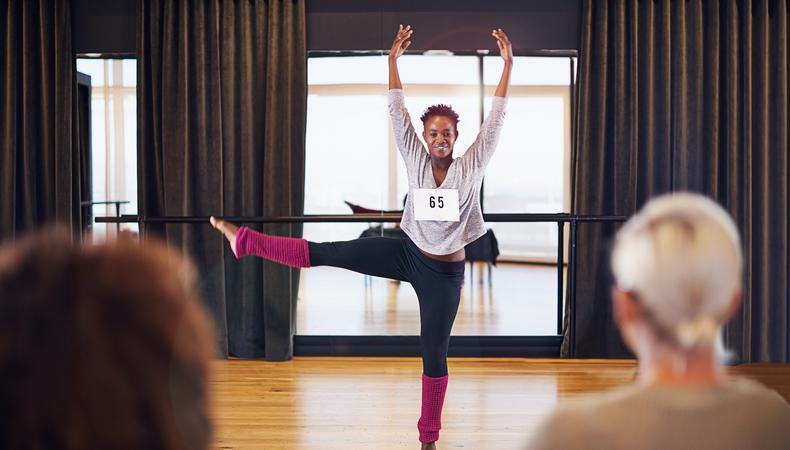
Dance auditions may feel daunting at first, but they’re an integral part of a dancer’s career. If you want to start landing dance jobs, you need to be able to embrace the audition process.
There is no one-size-fits-all process for dance auditions in the UK. “Every audition will be completely different based on what’s required for the job or for the agency [you are auditioning for],” says choreographer and dance instructor Claudimar Neto, who is the founder of training organisation Insight Dance Company.
That said, there are some similarities across the board, and it’s useful to be as informed as possible about the potential ways a dance audition may play out before you enter the room.
JUMP TO
“Typically, dancers register, learn a movement phrase or combination, and then perform it in smaller groups so the panel can see each person more clearly,” says instructor and choreographer David Blake, the founder of dance and mentoring collective Blake Arts.
He adds that some auditions also include a technique class, improvisation, or additional tasks.
Neto says dancers will almost always be taught the choreography during the audition. In rare cases, where lots of dancers are being seen – he gives the example of auditions for Beyonce’s Renaissance tour in 2023 – performers may be sent videos of a routine to learn beforehand.
Open call vs. invited auditions
Auditions described as an “open call” generally mean “anyone who meets the advertised requirements [can] attend or register, although advance booking may still be necessary,” Blake says. On the other hand, an invited audition means “the casting team has selected people to attend, often after reviewing applications, CVs, photographs, or footage.”
Cuts
Auditions often will be split into different stages, with a large number of dancers performing the routine simultaneously. A portion of dancers will be cut from the audition at each stage.
“Some dancers will be asked to stay and learn more material, while others will be released,” Blake says, adding that some dancers may receive a callback to give the casting team “another opportunity to assess suitability, sometimes through different material or alongside other performers.”
“Cuts can feel quite brutal,” Neto says, but he urges dancers to remember that “it’s not a personal thing.” Cuts can often be made for reasons entirely outside of a dancer’s control, and unrelated to their talent. Casting directors may, for example, be seeking dancers with a particular look or of a certain height.
“I try to get [dancers] to understand that you’re probably just not right for this job, or you’re just not right for me,” he says. “It doesn’t mean that it’s a no forever. It could be that you’re right for a different job with me.”
Credit: PeopleImages/Shutterstock
Here are some of the main types of dance auditions.
Commercial
Commercial dance can include roles in music videos, advertising, and live artists’ performances. Any type of dance style – from hip-hop and street dance to jazz and heels – could feature in a commercial video.
In a commercial dance audition, “there may be a strong emphasis on a particular style,” Blake says, while the panel could be looking out for evidence of “picking up choreography quickly, personality, and how you perform on camera.”
Freestyle may be requested as part of the audition, Blake says, and when it comes to finding dancers for a live artist’s performance, “casting may be shaped by the creative vision for the show and how the dancers complement the artist on stage.”
Musical theatre
Blake says the panel may focus on a dancer’s “character, musicality, and ability to communicate through movement” in musical theatre dance auditions. “Stamina matters too; an ongoing production can involve a demanding weekly performance schedule, so dancers need to sustain the work beyond the audition itself.”
It depends on the role, but singing and acting may also be part of the process for some parts for dancers in musical theatre.
Contemporary dance
Contemporary dance auditions may involve aspects such as a technique class, repertoire, improvisation, and creative tasks.
“Alongside technical ability, the team may want to understand your movement
qualities, artistic choices, and how you contribute to a creative process,” Blake says. “Your curiosity, willingness to explore, and readiness to take creative risks can also be important.”
Neto adds that the panel will be expecting dancers to be less “flashy” than in commercial or musical theatre dance, and instead “they’ll probably want you to be a lot earthier, a lot more [focused on] storytelling, a lot more connected with yourself and the ground.”
Now that you know more about the types of dance auditions, here are some tips on how to prepare for a dance audition and how to impress the panel once you’re in the room.
1. Dress suitably
You may be wondering what to wear to a dance audition.
Blake advises starting with the audition brief, and following any instructions specified for clothing or footwear. Otherwise, he advises dancers to “choose something appropriate to the style that allows you to move freely and lets the panel see your movement clearly.” Be sure to “wear something you have danced in before,” he adds. “You do not want to spend the audition adjusting your clothes or worrying about your shoes.”
Neto strongly advises dancers against wearing a costume. “That’s a pet peeve for a lot of people, especially myself,” he says.
2. Know the brief.
Do your research beforehand, Blake says.
“Understand who you are presenting yourself to and what they need,” he says. “Research the company, choreographer, or production, and think about how your skills can connect with the work.” He also suggests that dancers arrive with enough time to warm up and focus.
3. Nurture self-assurance
Neto urges dancers to focus on growing their self-confidence and to let go of perfectionism. “It’s about you being so self-assured that you know what you’re capable of,” he says. “It’s not about the mistakes. It’s not about, Am I perfect, or am I right?”
4. Be present in the room
It’s not just about how you handle the routine; the panel will also be aware of your focus and presence in the room more generally.
Neto says that when he is running auditions, he “[looks] at people and how they are communicating with others, and how receptive they are to the information [given].”
5. Get comfortable with being uncomfortable
Auditions are “never going to be a comfortable situation, because they’re nerve-wracking and we’re human,” Neto says.
They will, however, form a huge and integral part of a dancer’s career, so Neto advises learning to “find comfort with the uncomfortability of the audition” and learning “how to override that nervousness and use it for yourself.”
One way to do that, he says, is to use the audition as an opportunity to ask if you want to put yourself in that environment and if it’s the right job for you, as well as if you’re the right person for the job.
Neto says that having that kind of awareness is what “creates longevity” in a dancer’s career.