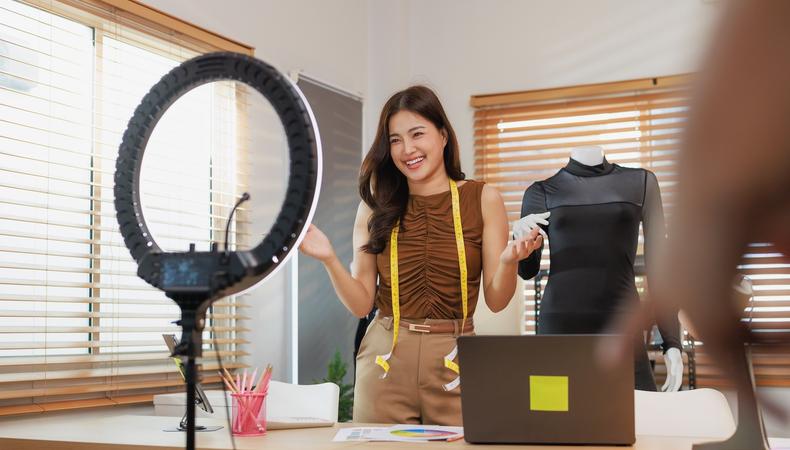
Ah, the humble ring light. Often fairly cheap and accessible, this portable, donut-shaped lighting fixture is the tool of choice for content creators and anyone who needs to light their face for a self-filming project or a killer selfie.
But how does a ring light work? What should you look for when purchasing one? What is the best way to use it? And is a ring light always the best choice?
We had a chat with award-winning cinematographer and photographer Tavis Pinnington (the feature film Westgate), and he shared some illuminating tips on how you can use a ring light to take your content to the next level.
JUMP TO
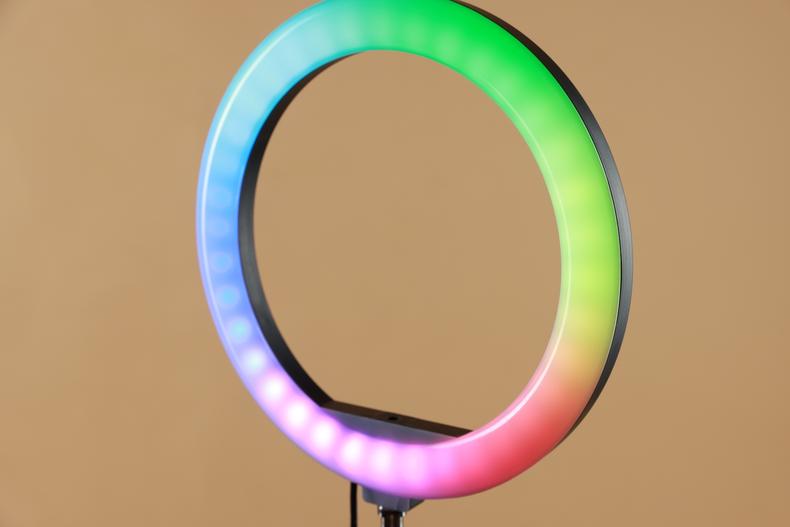
A ring light is a circular lighting fixture – usually composed of numerous small LED diodes, but sometimes made from a single fluorescent tube – which is designed to provide soft, diffused illumination directly onto a subject.
They were initially designed for dentistry and medical photography in the early 1950s, but they were later adopted by fashion photographers and then content creators. Ring lights became popular during the golden era of YouTube in the mid-2010s (you’d be hard-pressed to find a video of a vlogger like Jenna Marbles without circular lights reflected in her eyes). The popularity of ring lights jumped up again during the pandemic in 2020, as people sought to improve video quality for platforms like Zoom, TikTok, and Instagram.
Ring lights are predominantly sold as a DIY tool for front-lighting – i.e., the technique of illuminating a subject directly from the front, usually with a light source positioned behind the camera. Most modern ring lights are made so you can place your camera or smartphone in the middle of the circle so it is surrounded by light.
New Africa/Shutterstock
Ring lights typically provide a soft source of light, as opposed to a hard light source. They are primarily used to eliminate harsh, direct shadows; enhance skin tones; and reduce the appearance of redness and blemishes in photography and videography.
“Ring lights were made, I think, purely for beauty,” Pinnington says. “They offer a great light source for any kind of skin tone – dark skin tones, light skin tones. It’s a great all-rounder.”
“If you front-light your face with a soft light source like the ring light, it gives you something more pleasing,” he says. “If you use a hard light source, you’ll often get shadows under your nose, under your bottom lip, you’ll have shadows under your chin.… That’s probably not what you want to go for [if you’re looking to frame your face in a flattering light].”
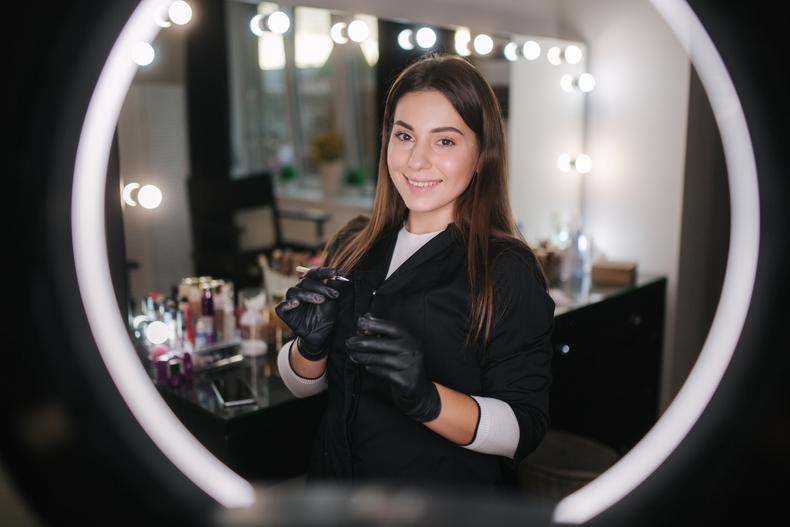
“The dead giveaway of a ring light is that they catch in the eyes when you look directly at the camera,” Pinnington says. “You can see this bright ring in your eyes. It is a very stylised look.”
For certain content, the ring reflection, or “halo eyes” effect, may be suitable. But if you want to achieve a more natural look, you can simply place the ring light off to the side of the camera – at a roughly 45-degree angle – so you aren’t looking directly into the light. This is a particularly good tip for filming self-tapes, because casting directors generally expect to see you lit naturally.
Studio113/Shutterstock
You can usually purchase a decent beginner ring light quite cheaply from places like phone shops, electronics stores, and online retailers. These are Pinnington’s top things to look for when selecting a ring light:
High CRI count: Look for a ring light with a Colour Rendering Index (CRI) count of 95 or above for “better colour accuracy.”
Dimmable: “You want a light that’s dimmable,” he says. “You want something that you can turn up and down depending on how powerful you want it, because sometimes you might not need a light that’s overly powerful.”
Multiple colour temperature settings: “One thing that I would look out for…is the option to change the colour temperature,” Pinnington says. “This is a bit more technical, but you might need to balance daylight or you might need to balance the tungsten [your usual electronic home lighting], depending on your environment.”
1. Invest in a good light stand
A cheaper ring light will usually meet your needs when it comes to self-filming and taking selfies, but you don’t want to cheap out on the light stand.
“You want a good, sturdy light stand. I think this is overlooked a lot,” Pinnington says. “The stands that come with a lot of cheap lights, especially ring lights, tend to break quite easily. It’s worth investing in something that’s a little bit higher quality. Otherwise it just falls over and breaks really easily – and that’s also a safety issue.”
2. Don’t rely on a ring light alone
A ring light can be a very lucrative tool, but you also need to consider the suitability of where you’re filming. Is the room uncluttered? Where are your other light sources coming from?
“I think the best kind of light you can use is what’s been given to us – the sun,” Pinnington says. But when bright, natural daylight isn’t possible, a ring light is the next best thing.