Keen to sharpen your skills in acting off the cuff? Improvisation, or improv, involves actors spontaneously creating scenes, characters, and dialogue on the spot without rehearsals or scripts.
It’s often comic, but it can evoke a range of other tones and emotions. Various performance settings may feature improv, including improvisational theatre, which has become a popular stand-alone artform. And a great way to practice your improvisation skills is through some time-tested improv games.
JUMP TO
Improvisation is a key skill regardless of whether you see yourself acting in improv theatre, since a good actor needs to be able to think on their feet, embracing versatility, spontaneity, and creativity in addition to learning lines. It can also be a useful technique for when lines are forgotten or something unexpected occurs during a performance. Ben Stiller famously forgot a line while filming Zoolander and repeated the question, “Why male models?,” which his costar David Duchovny had just gone to great lengths to explain. The moment added to the humour of the scene, and made it into the final cut.
Improv may not seem as polished as scripted performance, but a lot goes into pulling it off seamlessly. Psychological studies have also shown that improv boosts confidence while decreasing stress and anxiety.
Drama improv games can be applied to any learning or rehearsal setting. Improvisational techniques such as status play, emotional commitment, and physicality all build on your overall skillset as an actor, including connecting with others, trusting your instincts, and not becoming overwhelmed if you make mistakes.
Whether you’re a teacher, director, or performer, improv games are fantastic tools to help actors get comfortable and stay present in a setting that offers a sense of fun and safety.
Improv games are meant to encourage participants to get out of their comfort zones, but it’s important for group leaders – whether they’re a teacher, director, or performer – to establish a safe, trusted setting for any improv games they use. Encourage participants to check in at the beginning of each session and disclose anything they want others to be aware of, such as physical injuries, how they are feeling, or if they are not comfortable with physical touch.
Monkey Business Images/Shutterstock
There are a huge number of improv games, and many popular games have several variations. They often are broken into specific categories to highlight their benefits or the skills they can help develop.
Icebreaker games
Great for new groups and drop-in sessions in which participants may not already know one another, icebreakers are a chance to get everyone acquainted by learning names and basic facts.
1. Moving Name
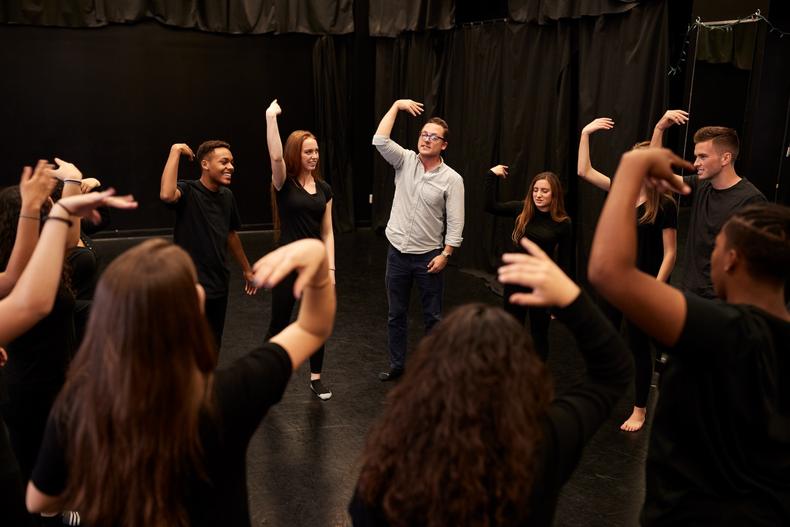
Form a circle. Ask one person to state their name with a physical gesture for each syllable and a distinct vocalisation, such as a high or low pitch. The more outrageous you set the standard, the better result you’ll get.
Once someone has performed their name, the whole group tries to copy their physical movement and how they said their name.
Continue around the circle until each person has said their name.
2. Foot Touch Tag
One person is “it,” and they must remain stationary. Everyone else pairs up. The pairs stand side by side, with one person’s left foot touching their partner’s right foot. (If either person isn’t comfortable with physical contact, their feet can be positioned next to each other without touching.)
The pairs then swap names.
The person who is “it” calls out a name, and the named person must run as quickly as possible to the “it” person without getting tagged by their partner. If they get tagged, they return to the pair. If they get away, they become the “it” person’s partner and their former partner becomes “it” and is responsible for calling out names.
If a name is called and the wrong person runs – typically because they’ve gotten confused by swapping names – they have to return to where they were standing in the pair.
Warmup games
These aim to get everyone comfortable, establish trust, and sharpen concentration. They’re especially effective at the start of a rehearsal or class, or in preparation for a show.
3. Bing
Stand in a circle. Pass a “whoosh” sound around the circle in one direction, clapping while pointing in the direction you want to send the whoosh. Try to speed it up each time.
Once everyone is comfortable, stop the whoosh and pass a “bing” sound. Use the same clapping action, but go in the opposite direction and say “bing.” Practice it a few times. Once everyone is comfortable, send a whoosh around the circle one way and a bing in the opposite direction at the same time.
Then add a twist: Any person in the group can change the direction of the flow by responding to a whoosh with a bing, or vice versa, sending the new sound in the opposite direction the original sound was travelling.
Once your group is comfortable with the first two sounds, you can add other sounds, such as “zap,” which goes across the circle.
4. Assassin
Everyone picks someone to be their bodyguard and someone to be their assassin. They keep it to themselves – no one reveals who they picked for what.
When the game starts, everyone tries to protect themselves by keeping their bodyguard between themselves and their assassin. Continue for a few minutes, and then stop the game when it seems appropriate. Have everyone reveal who they picked for what.
Association games
These improv exercises improve quick-thinking skills.
5. Animalistics
Ask the audience to suggest an animal for each actor to impersonate. If you’re in a class or rehearsal, you could split the group in half, with each taking turns being the audience.
Players improvise a scene in which their characters are based on the animals. They do not become the animals, but instead act out physical, vocal, or status-based characteristics of the animals.
6. Copycat
Two improvisers begin a scene. (They could be given a prompt by others in the group or suggest their own.) Everyone else in the group observes the scene. When an observer feels inspired, they can enter the scene by repeating a line that was just said. With their entry, the group begins a new, unrelated scene while the person who originally spoke the line exits the scene and joins the observers.
Gibberish games
These games, played in a made-up language, are designed to expand communication skills and encourage relying on emotions and physical expression as much as words.
7. Emotional Mirror
Split the group into pairs, facing each other. One person starts talking in gibberish, with a specific emotion, such as excitement. The other person instantly copies the emotion and speaks in their own gibberish.
After about 10 seconds, the second player changes their emotion and the first player must follow.
8. Backwards Interview
Think of a topic for a mock TV interview. Have two participants play interviewer and interviewee, but perform the interview backward. They start the interview with farewells, and work their way back to the intro.
Focus games
These help calibrate and settle a room at the start of a session or after a break.
9. Space Jump
Select a person to act out a scene on their own. They can offer their own prompt or be given one by the group. After some time has elapsed, call out “Space jump!” and have them freeze.
A second person enters and changes the scene radically. Whatever they dictate, the first person must “yes, and” and act out the new scenario.
Continue until everyone in the group is part of the action.
10. Thank You!
Form a circle. Invite one person to walk into the middle and form a frozen image with their body.
A second person then joins them, creating a complementary pose that builds on the first. The first person breaks their pose, says “thank you,” and exits the circle. Another then enters and builds on the second person’s pose.
Continue the exercise until everyone has taken part.