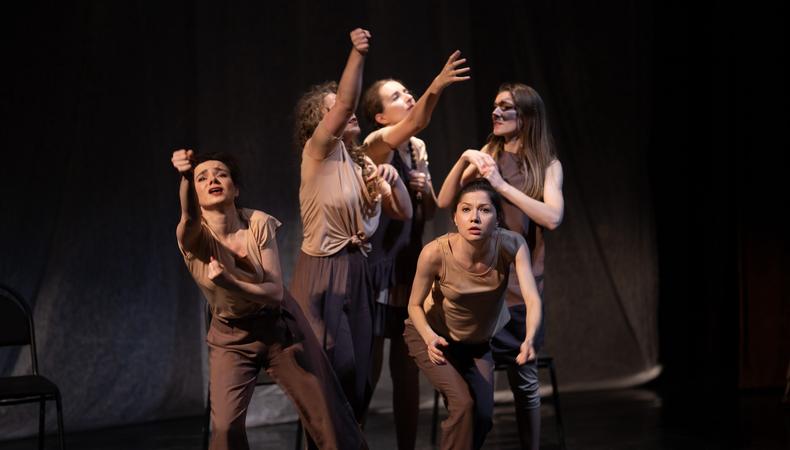
To verbalise the work of an actor is to try to pin down a volatile, intangible craft. An actor’s training encounters the very same problem: To study introspection and how to project it subtly to an audience is almost an obscure and mystical feat. Although theatre started to become popular entertainment in ancient Greece, it wasn’t until the first half of the 20th century that directors and performers began to articulate their practice and establish their methodologies more formally. Stanislavsky’s System, the Method, the Stella Adler and Meisner techniques all belong to this wave of newly formed definitions and approaches to acting.
A lesser-known framework for physical acting and movement is the Viewpoints acting technique. Developed in the 1970s in the context of experimental art by artist, professor, and theorist Mary Overlie and later expanded by directors Anne Bogart and Tina Landau, it diverges quite drastically from the aforementioned models. First and foremost, it asks its students to forgo the normal emphasis on text and traditional character study altogether. When Overlie published her findings in a 2016 book titled Standing in Space: The Six Viewpoints Theory & Practice, she presented the stage as a force that needs to be conquered. Bogart and Landau’s contribution, The Viewpoints Book: A Practical Guide to Viewpoints and Composition (which came a decade earlier in 2005), had already gone further, reconceptualising and supplementing Overlie’s theories by digging deeper into the intricacies of the Viewpoints training and including a vocal addendum to the study.
Overlie initially employed principles that related to tangible phenomena to build a performance from the ground up. Her original Six Viewpoints – space, shape, time, emotion, movement, and story – ask us to consider “dance and theatre as physical entities akin to natural landscapes that can be entered and traversed.” This theory and its ultimate application are divided into two parts: the Materials and the Bridge. The Materials (essentially the Six Viewpoints) are the raw tools of the theory, and the Bridge is the treatment of the philosophical and pedagogical concepts.
Bogart and Landau’s expression of Overlie’s Viewpoints theory is far more nuanced and articulated than their colleague’s, which tends to be more static and absolute than regular practice demands. The Viewpoints Book says that within Overlie’s Physical Viewpoints – the principles of physical movement through time and space – two further categories can be identified: Viewpoints of Time and Viewpoints of Space. They also add the notion of Vocal Viewpoints.
Viewpoints of Time
- Tempo: the speed at which something unfolds onstage
- Duration: how long each movement lasts
- Kinesthetic response: the performer’s individual response to the movement of other people or elements of stagecraft
- Repetition: the re-creation of something the company has previously done
- Viewpoints of Space
- Shape: the outline of the body in a specific space
- Gesture: a self-conclusive moment made with any part or combination of parts of the body
- Architecture: the physical environment in which movement happens and how it affects movement
- Spatial relationship: the distance between the elements (it could be between two bodies or groups of bodies, the actor and the audience, or even a person and the architecture that surrounds it)
- Topography: the patterns created by the movement that takes place onstage
To these nine Viewpoints, Bogart and Landau added a section on sound, addressing it as they address action. Instead of focusing on semantics, they level in on how words resonate and how sounds themselves contain information and expressivity. Their additional Viewpoints combine with tempo, duration, repetition, kinesthetic response, shape, gesture, and architecture, but not with topography, which is strictly physical.
Vocal Viewpoints
- Pitch: the highness or lowness of a sound
- Dynamic: how soft or loud a sound is
- Acceleration and deceleration: speeding up or slowing down
- Silence: the absence of sound
- Timbre: the quality of a sound, how it feels, and its texture
Different acting techniques suit different actors, but there are many benefits to the Viewpoints technique. It pushes the performer to look outward and engage with their environment firsthand rather than reacting to it according to their interiority. It actively encourages the actor to improvise and act upon their instincts, urging them to abandon structure. Viewpoints acting functions best when it’s adopted by an ensemble, because it promotes teamwork and collaboration. It breaks all naturalistic forms, pushing actors to use their imagination and prioritise allegory over a direct narrative. Observation is both the starting point and the objective; emotional storytelling and narration take the backseat.
The strategy, however, comes with a set of drawbacks for the uninitiated: The unpredictability of a Viewpoints-based creative rehearsal can be messy. It’s a matter of trial and error to see what resonates and what can be scrapped. Its quintessentially improvisational nature can lead to being too much of a diversion for actors and dancers who are accustomed to script-work or a heavily structured process, as well as those short on time.
The only way to find out if Viewpoints is for you is by trying it. There are many Viewpoints acting exercises online that will help you on the journey, but here are a few tips on how to plunge into the Viewpoints world.
- Be present. The Viewpoint technique won’t succeed unless you’re ready to give yourself to it fully. Forget your phone and glance around. Inspiration is everywhere, and every inch of the world can speak to you. The way we walk, the curve of the wall of a house. It’s easy to look without absorbing; try to appreciate what mundane objects and strangers on the street are trying to say about themselves.
- Be together. You need people. Viewpoints acting thrives on collaboration, so it’s essential that you find a group of like-minded people to practice with. By making art jointly rather than receiving a prewritten script, you will unlock the story you’re hoping to tell on a different level.
- Relinquish control. There’s no such thing as a mistake in Viewpoints acting, only happy accidents. Every choice and action will ultimately inform your performance. A whole universe of possibilities unlocks once you accept that there is no right or wrong.
You can learn more about Overlie’s work on her website, where you can find out about resources and workshops too.