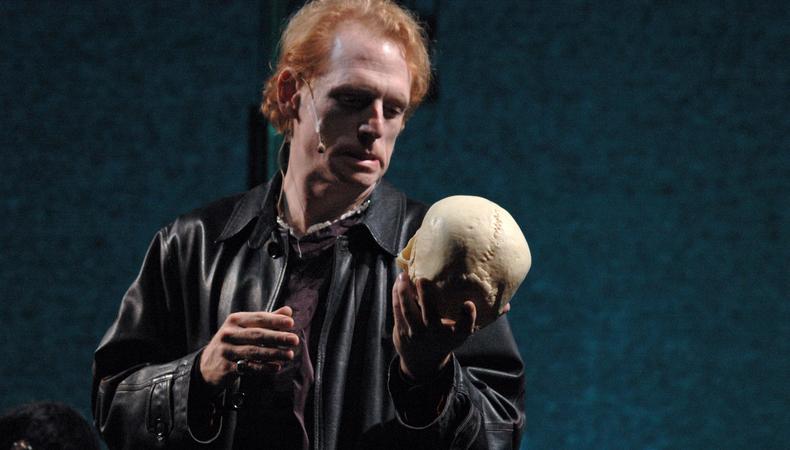
Shakespeare made them famous, but soliloquies are a timeless theatrical device to convey a character’s inner thoughts to the audience. From Macbeth’s vocalisations of guilt and dread to Tyler Durden’s reflections on modern life in Fight Club, the dramatic technique has long been used by writers of both stage and screen to grip audiences and heighten the drama. From how to develop your character to how to deliver a soliloquy to its fullest effect, here’s everything to know about one of drama’s greatest revelatory tools.
JUMP TO
A soliloquy is a form of dramatic speech that gives the audience a glimpse into a character’s innermost thoughts, feelings, and motivations without revealing these to the other characters. The character believes themself to be alone, out of earshot of everyone, including the audience. As opposed to ‘asides,’ when a character knowingly speaks to the audience, the character’s belief that no one can hear them leaves them free to reveal what they really think, feel, or plan to do.
The device was used prolifically by Shakespeare in plays including Macbeth, Othello, Hamlet, and King Lear, but it existed before then. Thomas Kyd and Christopher Marlowe used the technique in plays such as The Spanish Tragedy (1587) and Doctor Faustus (1592) before Shakespeare’s most famous soliloquies had been penned. However, historians think the term ‘soliloquy’ started being used in the 1600s.
Soliloquies and monologues are both forms of dramatic speech delivered by one character, but there are some differences between the two. The main distinction is that a monologue is delivered directly to other characters or the audience by a character who knows they’re listening. A soliloquy is spoken when the character thinks they’re in private, revealing their truest conflicts, dilemmas, and perspectives. The audience is a fly on the wall listening in.
Character development
Soliloquies are used for many different dramatic purposes, the most obvious being to give the audience a deeper understanding of a character and their state of mind. Being privy to a character's inner world can help an audience emotionally connect with them, understand their true motivations, and believe their decisions and actions.
Dramatic tension
The device helps create dramatic tension by giving the audience knowledge the other characters don’t have. Romeo’s final soliloquy in Romeo and Juliet is a great example: He reveals to the audience that he thinks Juliet is dead when they know she’s only sleeping. The speech heightens the drama as the audience fears what will happen as a consequence of his false belief.
Plot advancement
Soliloquies can also advance a plot, provide important backstory or information to the audience, and provide context for a character’s actions. Used appropriately, they provide an alternative to clunky, expositional dialogue and further investment in the story.
Soliloquies give actors the chance to deliver a memorable, standout speech. They create a revealing, intimate moment, which means they require extra attention to detail and delivery.
Here are some tips for performing a soliloquy with enough impact to blow your audience away.
Create a feeling of spontaneity
Soliloquies often see characters untangle things for themselves in an unselfconscious way. Each new thought should seem like it’s arrived at that very moment, even if you’re delivering the speech night after night.
Adopt a ‘first circle of attention’ approach
Since a soliloquy isn’t directed at anyone else, the characters will focus on themselves. As the speech is part of a performance directed at an audience, this requires a clever balancing act where the delivery is energetic enough to keep the audience engaged but simultaneously gives a sense of isolation, introspection, and ‘solitude in public’, as Stanislavski put it.
Understand the context
A soliloquy is the purest expression of a character’s thoughts and motivations, so it’s crucial to get a good grasp of your character, what’s brought them to this point, and what happens afterward – especially if you’re performing the speech in isolation as part of an audition or showcase. Don’t forget to consider their physical location – they’ll speak differently depending on how private the place is and how at ease they feel.
Know the objective
In addition to the character’s wider objectives in the context of the play, the speech will have an objective too. Get really clear on what the character wants, why they want it, and what they’re trying to figure out in this particular moment. That’ll keep the speech driving forward with energy and intention.
Hamlet, Act 3, Scene 1: “To be, or not to be.”
Probably the most well-known soliloquy ever written is Hamlet’s tortured, existential ‘To be, or not be’ speech. The speech is famous for exploring mortality since Hamlet is revealed to be contemplating whether life is worth living. The soliloquy has the potential to powerfully affect an audience as they empathise with his desperation and humanity.
Macbeth, Act 5, Scene 5: “Tomorrow, and tomorrow, and tomorrow.”
In this speech, the defeated, guilt-ridden Macbeth muses on the meaninglessness of life. We’re given a sense of his disjointed state of mind as he jumps between topics, and his reference to death is a reminder of all the death he’s been surrounded by and responsible for throughout the play. The soliloquy is one of the most famous passages in English poetry, thanks to its tight verse structure and vivid imagery.
A Midsummer Night’s Dream, Act 1, Scene 1: “How happy some o’er other some can be!”
Helena’s monologue in the first scene of this Shakespeare comedy lets the audience know she’s in love with Demetrius. Giving the audience this knowledge, which the other characters don’t have, makes the subsequent mix-ups and confusions all the more comedic.
Faustus, Act 5, Scene 2: “O, Faustus, now hast thou but one bare hour to live.”
Faustus’s final soliloquy is a vocalisation of his thoughts as he awaits certain death. Playwright Christopher Marlowe creates tension by indicating the passage of time over the course of a fictional hour, using the sound of a clock striking to heighten the sense of impending doom. The speech explores how time passes for the terrified Faustus and helps build empathy for him as his panic rises and the end of his life approaches.
Mr. Robot: “F*ck Society”
The first episode of the series Mr. Robot opens with Rami Malek’s character, Elliot, being asked by his therapist what he’s thinking. Between sharing thoughts with her, the audience is let in on his real, private thoughts, revealing more about his character’s personality and trajectory. The device creates immediate dramatic tension as we get a glimpse of this nihilistic scammer’s inner world.
Taxi Driver: “You Talking to Me?”
Robert De Niro’s character, Travis Bickle, delivers this famous, frequently quoted soliloquy to himself in the mirror. While he’s imagining delivering the lines to another character, he believes he’s in private and unselfconsciously reveals the extent of his revenge fantasies to the viewer.
Clueless: “I love Josh”
In the 1995 film Clueless, Cher, played by Alicia Silverstone, lets us in on her conflicts, dilemmas, and beliefs through her soliloquised narration. In this scene, we’re let in on her internal dialogue as she tries to understand her feelings toward her stepbrother, with the ultimate revelation that she’s in love with him.