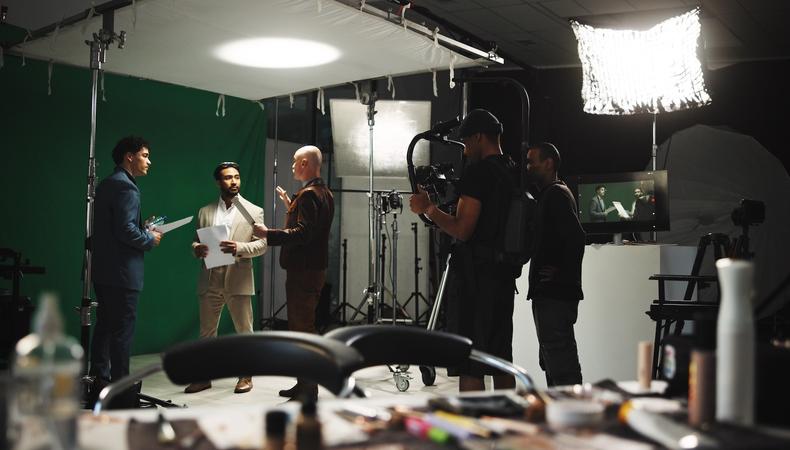
If you’re relatively new to the acting game or the majority or your acting experience to date has been performing onstage, the thought of filming on a professional set for the first time may be as daunting as it is exciting. Sets can be large, chaotic places with many moving parts. For actors new to film and TV, having a good grasp of on-set etiquette and film set rules is likely to leave you feeling more confident on your first day. Plus, the more you know about filming etiquette, the more likely you are to make a good impression on the job, which could positively impact booking work in the future.
We spoke to film and TV actors Vera Chok (Tommy and Tuppence, Hollyoaks, The Man Who Fell to Earth) and Laura Evelyn (Last Christmas, Good Omens, Black Mirror) about the dos and don’ts of working on a professional set.
Do know your on-set point of contact
“Look at the call sheet and learn the set runner’s name,” Evelyn says. “They might be down as runner or base runner or second assistant director (AD) or third AD.” This is the person who will meet you on arrival, and will be responsible for taking you to your trailer, to hair and makeup, and to set. “You will have a strong relationship with this person,” Evelyn says, “so knowing their name is a good shout.”
Don’t be late
First impressions count, and showing up late is not a good look. Check the call sheet for when you’re expected to arrive and “be on time or early,” Chok says. If you’ve been booked as an actor for a role in a commercial, TV show, or film, it’s highly likely that production will have arranged a car to collect you and take you to set, so “be ready to get picked up [at the stated time],” Chok says. “If your transport doesn’t arrive, keep production informed.” If you are a supporting artist, you will likely need to make your own way to set by the specified call time. Punctuality applies to the rest of the filming day too. If you’re told you need to be ready in costume and makeup at a certain time, then be ready.
Do follow instructions
“Pay attention when people give you instructions, and ask questions before you start shooting if you don’t understand,” Chok says. In terms of your safety on set, actors should “do what you are told, stand where you are supposed to stand, and don’t touch any lights, cables, or anything you aren’t supposed to,” she says. However, “if you are asked to do something which you do not feel safe doing, you can say no.”
Don’t wander off
“Production needs to know where you are at all times,” Evelyn says. “‘Hurry up and wait’ is the motto.” Even if you’ve been waiting an hour past your call time to start shooting, never wander off because production will expect you to be ready to go at a moment’s notice. If you need to use the toilet, then it’s crucial that you inform the set runner so they know where you’re going. Otherwise, stay put.
Do treat everyone with respect
It should go without saying to treat everyone working on the set with respect, from the director to the gaffer. Where you can, “try to learn people’s names, or have a copy of the call sheet in your pocket to refer to,” Chok says. You may feel like the centre of attention being the one on camera, but try to remember that “you are an equal part of a larger process,” Evelyn says. Don’t mess around or waste people’s time. Be professional, be polite, and be pleasant, and people will want to work with you again.
Don’t try to network or pull focus
You have been booked to do a specific job, and you should respect the chain of command and hierarchy on set. “Deal with the people who you have been introduced to,” Chok says, and “let the director and first AD get on with their jobs.” Particularly if you are a supporting artist, focus on the job you’re there to do rather than trying to network with or get the attention of the director or cast members.
Do be mindful of what you say on set
“Remember that you are mic’d,” Evelyn says. Film set etiquette means “the soundie [sound recordist] will generally turn off your mic from their end when your audio is not needed” (and they will certainly turn it off if you need a comfort break), but Evelyn advises actors to “be discreet” about what they say between takes as your audio could still be on. Avoid using explicit language and certainly don’t badmouth anyone or gossip (which we’d recommend you avoid completely on set anyway!).
Don’t photograph or film the set or other actors
Under no circumstances should you take photos or film any part of the set or the other actors without permission. Doing so is likely to be in breach of your nondisclosure agreement (NDA) or contract. When it comes to phones more generally, it is essential that they are on silent – and potentially even airplane mode – so there is no chance of them disrupting the shoot.
Do take care of your costume
It’s important to take care of your costume on set, particularly when you’re eating and drinking. “If you’re settling into lunch for an hour and you can take your costume off, do it,” Evelyn says. If taking your costume off isn’t an option, then she suggests “tucking a napkin or tea towel into your neck” to protect your attire. Any stains or damage to your character’s clothes will make the costume department’s life really hard, so try your best to look after it.
Don’t eat or drink on set
There are designated areas and times to eat during shoots, and the set is not one of them. “If you have a designated health condition and you need sugar every two hours, for example, you are responsible for having snacks with you and letting production know about that,” Chok says. “And, obviously, if you need water whilst on set filming, then of course you can ask.”
Do leave your trailer or dressing room tidy
If you’re an actor hired to play a role on a film set – i.e., you are not a supporting artist or a featured supporting artist – then you will have your own trailer or dressing room. Evelyn stresses the importance of “leav[ing] your trailer in as nice a condition as you can” when you finish for the day. You may not be returning to that particular trailer the next day, so leaving it in a good condition is not only respectful to the actor who may be using it after you, but it also ensures that none of the crew has to “clean up a mess you could easily tidy up yourself.”
Don’t take things without permission
It may be tempting to walk away with some memorabilia, but costumes, props, and wigs should remain on set at the end of filming unless you have explicit permission from the team, because “there may be reshoots,” Chok says. The production team may also have onward plans for wardrobe too.
Follow these dos and don’ts for your first time on set and you’re sure to make a good impression on your fellow cast and crew members.