
When consumers upload unboxing videos or post photos showcasing products without being paid or prompted, that’s organic user-generated content (UGC). It’s anything created and shared voluntarily by real customers.
Then there’s paid UGC. It involves hiring UGC creators to produce content that appears organic, then post it on your socials. Research shows that 92% of British consumers trust UGC more than traditional advertising, so it’s easy to understand why so many UK brands make it part of their online marketing.
What’s not easy is learning where to find UGC creators and how to hire the right ones. Selecting just one or two for small campaigns can be challenging. Hiring 10 to 20? That’s a genuine slog.
Let’s start by demystifying the whole process of finding, vetting, and hiring UGC creators.
JUMP TO
UGC creators and influencers both count as content creators able to promote brands on social media, but that’s about where the similarities end. Let’s hang fire on finding available UGC creators and ensure that they’re genuinely what you need.
Personal following
UGC creator: Unimportant. They can produce effective brand-focused content without large followings.
Influencer: Important. They rely on large audiences who trust their judgement.
Content style
UGC creator: Authentic. Seemingly organic and unpaid.
Influencer: More polished. Openly paid.
Cost per post
UGC creator: Averages from £50 to £250.
Influencer: Depends on their influencer tier. Averages are £20 to £150 for nano influencers and £8,000 to £40,000 for mega influencers.
Deliverable
UGC creator: Content for brands to post on their own socials.
Influencer: Promotions incorporated into the influencer’s content and feeds.
UK law stipulates that whoever creates original videos, scripts, graphics, or captions usually owns the copyright. Payment does not automatically transfer ownership. Brands essentially receive a license to use content for agreed campaign purposes; anything extra typically increases base rates.
Brands may pay for:
- Full ownership: Allows perpetual use of content across advertisements, marketplaces, and platforms. Expect to pay 50% to 150% extra.
- Extended use: Most licenses range between three and 12 months. Creators typically charge between 30% and 50% more for extended usage.
- Paid media rights: Organic content is posted on a brand’s channel, relying strictly on organic traffic. Paid media rights allow it to be used in paid advertising. Expect to pay 15% to 25% extra.
- Whitelisting: Allows brands to run ads through the creator’s social media handle over a fixed period. Expect to pay 25% to 45% extra.
- Dark posting: UGC appears in targeted feeds but not the creator’s or brand’s profile. Expect to pay 20% to 40% extra.
- Exclusivity: This limits whether a creator can work with competitors within your industry for a set period, usually 30 to 90 days. Expect to pay 30% to 50% extra.
The processes of hiring a UGC creator and hiring an influencer are often treated interchangeably, but they’re not one and the same. One involves buying content your brand can use; the other involves paying influencers to advertise on your behalf.
Here are eight questions to help pinpoint the perfect UGC partner.
1. How well do they perform on camera?
When UGC creators perform poorly, so does their content. Kick off your vetting process by reviewing previous work.
- Believability: Can they present products without sounding scripted? Do they feel like everyday people rather than polished influencers? Does their enthusiasm for brands ring true? Remember that inauthentic content won’t convert.
- Watchability: Is their content actually enjoyable, or are you itching to scroll away? Red flags include straying off topic and cramming too much into short videos. Green flags include speaking as if they’re chatting with friends and appearing confident, positive, and expressive.
- Suitability: UGC creators should vibe with your brand and customers. Do prospective creators look, talk, and, perhaps most importantly, feel akin to your target audience? Do they reflect your style and values? Have they ever included anything potentially offensive or misleading?
2. Are they consistent?
Check any Instagram “highlight” reels that showcase their previous work. You can also dive into their profiles and check video content posted during different time periods. You’re looking for consistent excellence, not just peak content.
3. How experienced are they?
Any UGC experience is good. Relevant experience is better. Has the creator worked in or adjacent to your industry? Do they understand technical specs, common industry language, and customer pain points? Do they appear genuinely knowledgeable?
4. Is their content good quality?
“Low-quality UGC diminishes consumer satisfaction, reducing their engagement,” researchers Bei Bian and Haiyan Wang write in their research paper “Quality Management and Feedback Operation for User-Generated Content Considering Dynamic Value Belief.” “Conversely, consistently high-quality content enhances perceived value, fostering sustained participation.”
As such, UGC shouldn’t feel professionally produced, but it should meet certain standards.
- Audio: Background noise should be minimised. Audio should come through cleanly and clearly with volume balanced across cuts.
- Video: Resolution should be 1080p at minimum, and 4K for futureproof content. It should always be filmed vertically in 9:16 for short-form video, with no jerky camera movements or shakiness.
- Lighting: Look for natural, frontal lighting that presents both creator and product clearly without any harsh shadows or overexposure.
5. Do they understand UGC fundamentals?
Effective UGC seamlessly weaves selling fundamentals into organic content.
- Hooks: Do videos engage within those vital first three seconds?
- Call to action: Do they finish by clearly driving viewers to take certain actions?
- Onscreen text: Do onscreen text or captions boost clarity and accessibility?
- Descriptions: Are they optimised with keywords and hashtags?
6. What’s the quantity and quality of engagement?
Interactions between viewers and content count as engagements – likes, shares, saves, and comments being the most common. They show that content is truly resonating rather than simply being viewed.
With that in mind, head to wherever their previous work is posted and check:
- Engagement rate: Combine the number of engagements, divide by total followers, then multiply by 100. Average rates vary across industries, platforms, and niches, but higher is always better.
- Comment quality: Do audiences react positively? Are they actually enquiring about products or tagging friends to recommend them?
7. Can you check their feedback?
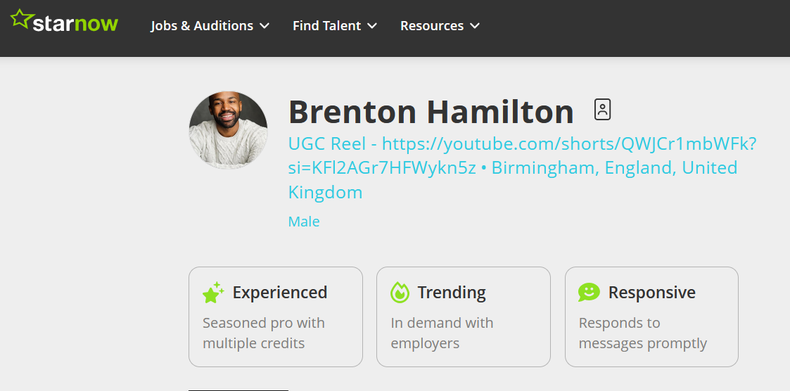
One advantage of a dedicated UGC creator platform is instantly showing how creators are rated by previous clients. Brenton Hamilton’s StarNow profile, for example, credits him as experienced, trending, and responsive.
You could also:
- Request performance data from previous campaigns.
- Check a creator’s reviews on different platforms.
- Search personal sites and portfolios for feedback, checking LinkedIn to ensure that listed contacts are genuine.
8. Could you try a paid sample?
Asking creators to produce one video at your standard rate (with the possibility of more to come) is a surefire way to select the right people.
“Each creator brings their own energy to the content,” explains Hustler Marketing’s Marina Taylor. “That’s why promising ads sometimes fail, even when all the demographic factors are correct on paper.... By testing multiple creators, you can pinpoint the ones who really resonate with your audience…avoiding costly dead ends and identifying the UGC creators who are most likely to net you high revenue.”
Pay attention to:
- Response speed and clarity
- Willingness to discuss briefs and take direction
- Ability to meet deadlines and handle criticism
And here’s the million-pound question: Would you run their sample UGC without hesitation?
UGC creators work best when they’re made aware of what they’re working toward. Enter the UGC brief, which should contain:
- Campaign goals and key performance indicators (KPIs)
- Content requirements (platform, format, length, quality, etc.)
- Key messaging
- Brand and content guidelines
- Deadline, feedback, and communication guidelines
Hammering out these details right off the bat prevents potential misunderstandings and lays out all the aims an experienced UGC creator can help brands achieve.
UGC content may appear organic or unsolicited, but, legally speaking, paid is paid.
Per the Advertising Standards Authority (ASA): “If you’ve been incentivised in any way to promote a brand or product in your social media content, it’s important that all this content is clearly identifiable as an ad (or advertising), and reflects your genuine experience.”
In a nutshell: All UGC you commission must be labelled as an ad.