If getting paid to read books aloud while bringing their characters to life with just your voice sounds like your dream job, audiobook narration may be the thing for you. Recording audiobooks has made the voices of well-known actors such as Stephen Fry, who narrated the Harry Potter book series, recognisable in households all over the world. It’s a rewarding way to hone your vocal skills while bringing stories to life in the minds of your audience.
Audiobook narration is a valuable string on any performer’s bow, but it can also be the whole orchestra if you’re good at it. A combination of performance skill, technical know-how, and plenty of practice will help you captivate your listeners with just your voice.
Here’s how to prepare for a career as an audiobook narrator in the UK.
JUMP TO
Range
Listening to someone speak in a monotone voice for a long time can be deadly dull. Varying pitch, tone, and pace brings light and shade to your narration. Different genres will call for different vocal styles, so the wider your range, the more audiobooks your voice will suit. A deep, sombre tone may suit a brooding tragedy, for example, while a suspenseful romance may require a bouncier, more playful delivery.
Breath control and voice protection
Books often contain long, complex sentences structured with silent reading in mind, and narrating a whole book can tire out your voice. Breath is your voice’s fuel, and good control helps sustain your narration without sounding strained or taking audible breaths. Audiobook narrators are typically expected to record for around six hours a day, so it’s vital to ensure that your voice is rested and well lubricated with herbal teas and plenty of water.
Work with the microphone
It may sound obvious, but speaking inches from a microphone means everything is amplified. Take extra care over plosives such as P and B, which can create an explosion of sound if they’ve got too much breath behind them. If you’re using more volume – if a character shouts, for example – step a few inches away from the mic so you don’t burst your listeners’ eardrums!
Character voices
Distinct, believable character voices help your listener distinguish between speakers. Accents and dialects are a great way to do that, so it’s worth perfecting a few. Received pronunciation (RP) is still widely used for audiobook recordings, unless a book is set in a specific region. It’s handy to have some regional variations under your belt, too, as well as a neutral English accent.
Articulation and diction
Speaking clearly is more important than ever when your voice is doing all the work. Every syllable needs to be crisp and clear so listeners can follow the story without missing a beat. Good articulation is easier and more relaxing to listen to, so your audience can become immersed in the nuances of character, emotion, and atmosphere without any of it getting lost in mumbled words or phrases.
You don’t need professional vocal training to narrate an audiobook (prior experience and a winning voice reel may be enough to book you the job), but it may be worth booking a few vocal classes to nail the basics.
One of the benefits of being off camera is that you don’t need to learn your lines, but you do need to rehearse your delivery. Practising out loud helps you spot places where you may trip up, while getting your mouth around long, tricky-to-pronounce words and finding natural places to breathe. Practise reading all kinds of texts – fiction, nonfiction, poetry, or even a newspaper column – out loud as often as you can, focusing on pacing, rhythm, and expressiveness. It’s a good idea to record yourself and listen back so you can identify areas for improvement.
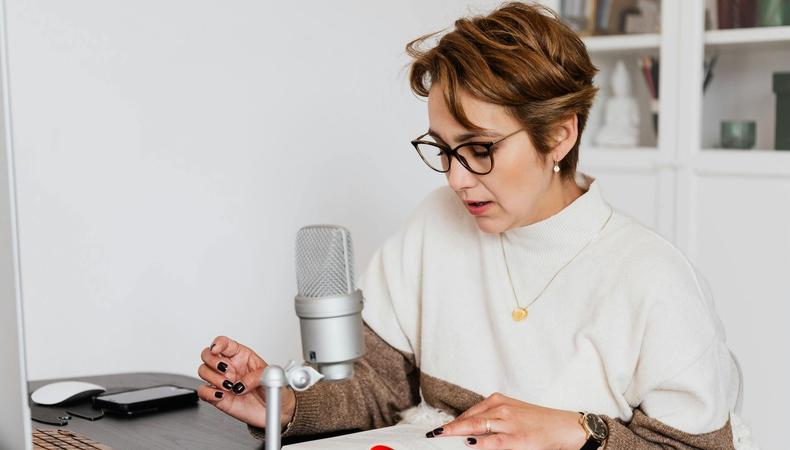
Clients will often book recording studios for professional jobs, but voiceover artists increasingly are expected to record from home. Having an at-home recording space can work to your advantage. It’ll save you having to travel for jobs, and once you’re set up with the necessary equipment, you’ll be able to record demo reels, auditions, and entire books without leaving the house. It doesn’t need to be fancy (it’s common to set up a soundproofed studio in a closet when you’re starting out), but the production quality needs to be high to give you the best chance of being considered for jobs.
Invest in basics such as a microphone, pop filter, shock mount, headphones, and an acoustic treatment such as foam panels or a duvet to soundproof the space. You’ll need audio software to record, edit, and master your narration. Free editing tools such as Audacity are a good place to start. If you’re after something more advanced, try paid software such as Adobe Audition, or Logic Pro if you use a Mac.
A demo reel is essential for submitting yourself for jobs and representation. Your reel should showcase your vocal range and ability to embody different character voices, as well as your narration skills across different genres, including fiction, nonfiction, children’s books, and poetry. As for tone, aim for at least two contrasting pieces, and think about including a couple you know work particularly well with your voice. You’ll be expected to adapt your narration to suit particular projects, but different voices are naturally more suited to certain styles. Imelda Staunton’s soothing, authoritative voice is perfect for a children’s book such as The Gruffalo, for example, while Tam Dean Burn’s voice captures the grit of Trainspotting. Establish your style and let it shine in your demo.
It may be tempting to cram as much as possible onto your reel, but try to keep it to 90 seconds and no longer than 15 seconds per voice. Agents and publishers get sent lots of submissions every day, so make sure yours grabs their attention quickly. Don’t forget to update your reel as you learn new accents and perfect your vocal skills.
Set up a website that lets people know what you do, with a bio that includes any training and experience you have, your demo reels, and your contact information. Create profiles on casting sites, which post details of open auditions and connect voice actors with clients for various projects, including audiobooks.
Connecting with other voice artists, authors, and publishers on social media and at industry events is another good way to hear about jobs and put yourself at the top of the right people’s minds.
A voiceover agent isn’t a must for getting audiobook narrator jobs, but it’ll certainly make your life easier. Research UK voiceover agencies that specialise in audiobooks, because they’ll likely have established relationships with audiobook publishers and production houses. Some traditional literary agencies have expanded to include voiceover departments to represent their authors (and sometimes other voice talent) for audiobooks, so it’s worth exploring those too.
The audiobook industry is always evolving, especially as technology advances and new media-sharing platforms are developed. Keep learning about new tech, best practices, and how the industry is growing and changing. Similarly, keep honing your vocal skills. Your voice is an instrument, and accents, range, control, and diction all need constant practise to stay sharp. You may want to consider investing in training and workshops to help you stay disciplined.
Audiobook narration is a creative, rewarding way to make books accessible to all kinds of people. All you need is a quiet space, a bit of equipment, and your voice, and you’re all set to transport your listeners to another world.