
Perhaps you were the kid who always put on accents to entertain your friends. Perhaps you’re now the grown-up with an uncanny ability to mimic the announcements on public transport, in supermarkets, and on the radio. However you’ve come to it, if you’re contemplating a career in voice acting, you’re probably wondering how to get started. Here are the steps to take to ensure your voice gets heard.
JUMP TO
Before diving in, it’s crucial to understand what voice acting entails. Voice actors lend their voices to a variety of projects, including commercials, animations, video games, audiobooks, and more. Research the industry’s niches to identify which areas interest you the most. Here’s a breakdown:
- Commercials: Voicing radio, TV, and online advertisements
- Animation: Voicing characters in cartoons, films, and TV shows
- Video games: Voicing characters and narrating video games
- Audiobooks: Narrating fiction and nonfiction books
- E-learning materials: Providing voiceovers for educational content and corporate training
Voice acting requires a number of skills, including voice control and modulation. Here are some things you can practise at home to strengthen your vocal cords and expand your range.
Breath control
Breathing techniques help you control your breath to maintain consistent vocal performance. Mastering your breathing will reduce the number of times you have to break to catch a breath. Singing exercises can be useful for this.
Articulation and diction
You will need to speak clearly and crisply so that all your words can be understood. Record yourself and make sure you can hear the beginnings and ends of your words, ensuring they aren’t running together.
Accents
Until relatively recently, voice actors were expected to be vocal shapeshifters, shrugging accents on and off with ease. The trend is now to cast actors with native accents. However, if you want to get into voice acting for video games, it can help to have a range of accents under your belt, especially for crowd scenes. Start by mastering RP (received pronunciation or standard British) and standard American, then build up your repertoire.
Emotional range
As a voice actor, you will need to convey a range of emotions with just your voice, so experiment with sounding out different emotions and tones as a way of bringing characters to life. Children’s picture books can be useful to practise with because they often contain a range of different characters with heightened emotions.
Reading and interpretation
Practice reading different types of writing aloud to get comfortable with different styles and formats. Pick up a newspaper or magazine and read an article out loud; grab a nonfiction book and see how you fare with technical or academic language; and try reading a short story to practise pacing, slowing at the dramatic parts and speeding up in the less important sections.
Character development
Work on creating distinct voices for various characters, focusing on their personalities and traits. Take a novel and find sections where several characters have dialogue. Practice switching between characters and narration, making sure you have distinct voices for each.
Soloviova Liudmyla/Shutterstock
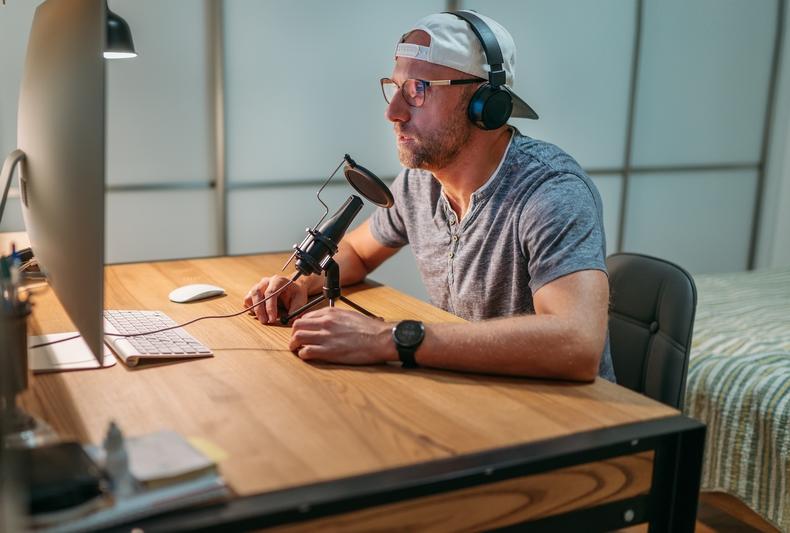
You don’t need a high-end studio to get started as a voice actor, but having a quiet, dedicated space for recording is essential. Established voice actors have long had recording equipment at home, but during the pandemic, this became a necessity for anyone wanting to take on voice acting work. Now it is considered the norm to record at home, and actors who can offer this service typically find more work.
Home studio essentials
Microphone: Invest in a good-quality microphone suitable for voice recording.
Pop filter: This piece of equipment is essential as it reduces popping sounds from plosive consonants, such as p’s and b’s.
Audio interface: This hardware device connects audio equipment, such as microphones and instruments, to a computer. It acts as a bridge between the analog and digital worlds, converting analog audio signals into digital data that the computer can process and vice versa.
Audio software: This connects your microphone to your computer. You can use built-in software, such as Apple’s Garageband, or invest in something bespoke.
Headphones: You’ll pick up more fluffs and popping sounds with headphones than you will listening through your computer’s speakers. This will make your job easier when listening back to the recording for the edit.
Soundproofing: Use foam panels or other materials to minimise background noise in your recordings. Some actors repurpose an old cupboard to record audio, which can be soundproofed by taping old duvets to the inside.
A demo reel is your voice acting portfolio, showcasing your range and abilities. It’s one of the most important tools for getting noticed by casting directors and potential clients.
Tips for creating a great demo reel
1. Keep it short: Aim for 60 to 90 seconds, highlighting your best work.
2. Show your range: Include different types of voice work. For example, you could include a radio commercial, a section from an animation, and a paragraph of narration.
3. Professional quality: Ensure your recordings are clear and of high quality. If possible, work with a professional to produce your demo.
Having an online presence is crucial in this digital age. Create profiles on voice acting platforms and social media to showcase your work and connect with potential clients.
Voice acting platforms
- StarNow: Sign up, complete your profile, subscribe, and then apply for voiceover jobs through the platform.
- Voice123: Creating a profile is free; a subscription allows you to audition for voiceover gigs.
- Voices.com: You can sign up for free; to apply for jobs, you’ll need a premium subscription.
Starting a voice acting career with no experience is challenging but entirely achievable if you dedicate yourself to developing your skills. Creating a professional home studio, a demo reel, and an online profile will help you begin to build a successful career in voice acting.