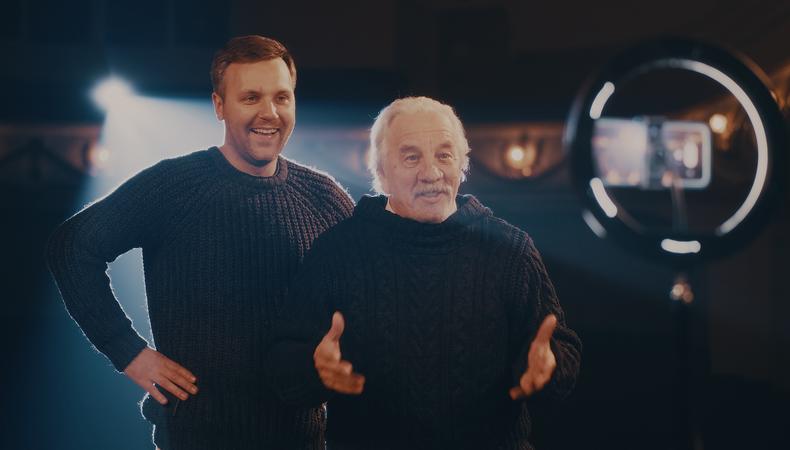
Is it too late to become an actor? If you’re wondering whether you’ve missed your chance to pursue acting, the answer is no. In fact, your maturity could be an advantage.
Perhaps you’ve always wanted to act, but you spent your 20s building a career and your 30s raising a family or simply figuring out what you wanted from life. Perhaps you’ve reached 40, 50, or 60, and finally decided it’s time to pursue the creative ambition you’ve been putting off.
Whatever your circumstances, you may be wondering if it’s too late to become an actor. According to Australian actor and acting teacher Mark A. Hennessy, it’s never too late.
“I think, up to a certain point, everybody can learn how to act,” Hennessy says. “There’s no one who couldn’t come to an acting class at any time of their life and get something from it.”
Hennesy’s decades-long career spans theatre, TV, and film, from starring opposite Kylie Minogue in children’s series The Henderson Kids to roles in series such as Blue Heelers and All Saints. He’s also appeared onstage with some of Australia’s most respected theatre companies.
As a teacher at Melbourne acting school Brave Studios, he has helped actors of all ages start building their careers. Hennessy says he believes that having more life experience can be an advantage.
Acting may involve “imaginary circumstances,” he says, but actors draw on things they understand from their own lives – which means an adult beginner can bring experiences and perspectives that a younger actor simply hasn’t had the opportunity to develop yet.
Some of Australia’s most beloved actors got their start later in life. If you’re hoping to follow in their footsteps, where should you begin?
JUMP TO
When it comes to breaking into acting with no experience, Hennessy’s first piece of advice is simple: Get some training.
Community theatre can be a valuable way to meet people and gain experience, but he recommends beginning with serious acting training rather than relying on community theatre alone, especially if your goal is to pursue a new career rather than a new hobby.
“Training is essential,” he says, adding that aspiring actors should look for a reputable institution and remain alert to whether what they’re being taught seems sound. There isn’t one universally correct acting technique, and there are many types of acting classes to choose from.
Hennessy has trained in several approaches throughout his career, and stresses that emerging actors benefit from developing a broad understanding of different methodologies and discovering what works for them.
“When you see great acting, it looks effortless, but that’s an absolute illusion, as it should be for the general public,” he says. “But that illusion of spontaneity and simple ease is based on an enormous amount of hard work.”
For adult beginners, part-time courses and training can also be an accessible way to get into acting without immediately committing to a full-time drama school programme.
At Brave Studios, for example, Hennessy teaches introductory classes alongside eight-week term courses, with many classes scheduled at night. The format allows students to train around existing work and other responsibilities.
Before committing to a particular school or course, you should research the teachers, their professional experience, and the type of training offered. If possible, try an introductory class before signing up for a longer programme.
One of the biggest concerns for older beginners is that they’re starting with a disadvantage. Hennessy suggests flipping that idea around, encouraging older actors to recognise the experiences and skills they bring with them as a potential “superpower.”
Maturity can bring discipline, perspective, and a deeper understanding of people and relationships. It can also help actors draw on a broader range of personal experiences when approaching a role.
There is a caveat, however: Acting requires vulnerability. Hennessy says some older students can initially find that difficult, because they’re more accustomed to knowing how things work in their lives. Acting, by contrast, requires risk-taking, experimentation, and failure.
The willingness to be a beginner again is therefore one of the most important qualities you can bring to the classroom.
“Sometimes older people are a little bit more resistant,” Hennessy says. “But, of course, any artistic or creative work requires risk-taking and failure. Sometimes that’s hard, because they want to know how to do it straight away.”
“But in the same breath, I’ve had older students who are completely open when they come to learn and become quite good in a short amount of time,” he continues. “Finding that place in themselves where they can be released and present, which is what you have to do in every moment of every scene, that’s as foreign to a high school student as it is to an elderly person.”
Once you’ve started training, you can begin looking for opportunities to put your skills into practice. Don’t assume you need to land a starring role immediately. Like any skill, acting takes time to develop.
Hennessy compares the process to learning to drive a manual car. At first, you’re thinking about every individual technical element; eventually, with enough practice, those skills become instinctive. Acting works in much the same way.
That means you shouldn’t rush to get an agent or throw yourself into professional auditions before you’re ready. Hennessy warns that going out too soon – before you’re equipped to deliver consistently strong work – can result in a poor experience that may make future opportunities harder to secure.
Instead, use classes, workshops, student productions, independent theatre, short films, and other legitimate opportunities to build your experience and confidence.
And don’t overlook the value of creating your own work.
So, what roles are available to older actors?
The answer depends on the individual, but Hennessy says the industry will inevitably make assumptions based on how an actor looks, sounds, and presents. That’s the reality of typecasting.
Onscreen especially, where there’s almost always an emphasis on realism, actors may find themselves auditioning for roles such as teachers, lawyers, doctors, executives, or ageing parents, but that doesn’t mean you should limit yourself to those categories.
“I can play anything; just give me the shot” is the attitude Hennessy recommends.
One way to challenge those assumptions is to make your own work. If there’s a particular type of character you want to play, create a scene, short film, or theatre project that allows you to demonstrate those skills.
“Don’t let the business limit you,” Hennessy says. “If you want to be seen in a particular way, then make your own work and just create it.”
That approach can also help you build credits while demonstrating range to potential collaborators, casting directors, and agents.

Credit: New Africa/Shutterstock
When you’re starting out, it can be tempting to decide that you only want to work in film, television, or theatre. But Hennessy recommends keeping your options open.
After all, in addition to the above mentioned areas, actors may build experience through commercials, voiceover, and even video games. You may discover that one form of work leads unexpectedly to another.
“Creativity begets creativity,” Hennessy says. “Art begets art.” That doesn’t mean you should say yes to every opportunity regardless of its quality or suitability. It means you should be willing to explore different forms of performance while you discover where your strengths and ambitions lie.
And remember that acting professionally doesn’t necessarily mean giving up your existing career overnight. Many established actors continue to balance acting with other creative and professional work.
For many, particularly those beginning later in life, maintaining other work is simply part of building a sustainable creative career.
Perhaps the most important shift for any aspiring actor is understanding what you can actually control.
You can’t control whether a casting director chooses you. You can’t control how many productions are being made or whether an agent takes you on. You can’t control whether your big break arrives next month or in five years.
But what you can control is how seriously you take your craft.
“Everybody’s ambitious, and, of course, you want to work,” Hennessy says. “But the only thing you’ve got control of is the quality of your work. That’s the thing to attend to.”
Yes. But starting doesn’t mean instant success. It means being prepared to learn, practise, fail, try again, and keep developing.
As Hennessy puts it: “If it’s for you and you want to do this work, then you have to grab at it. You have to have a go.”