
There’s so much talk around influencer marketing that knowing exactly how and why it can impact your brand tends to get lost in the noise.
You know that finding influencers to promote your brand has the potential to work wonders, but how do you know which influencer to pick? Or what your campaign goals should be? Or why influence marketing is so important?
Here’s a primer on what social media influencer marketing involves, why it works, how you can get started, and what results it can yield.
JUMP TO
Influencers are content creators who are active on social media with large or highly engaged followings, usually in specific industries such as beauty, fashion, fitness, or food. Influencer types are typically broken down by follower count.
- Nano: 1,000 to 10,000
- Micro: 10,000 to 100,000
- Macro: 100,000 to 1 million
- Mega: Over 1 million
Influencer marketing partners brands with relevant creators. They post about your products and services, using their influence with audiences on your behalf in return for a flat fee, sales commission, or a blend of the two.
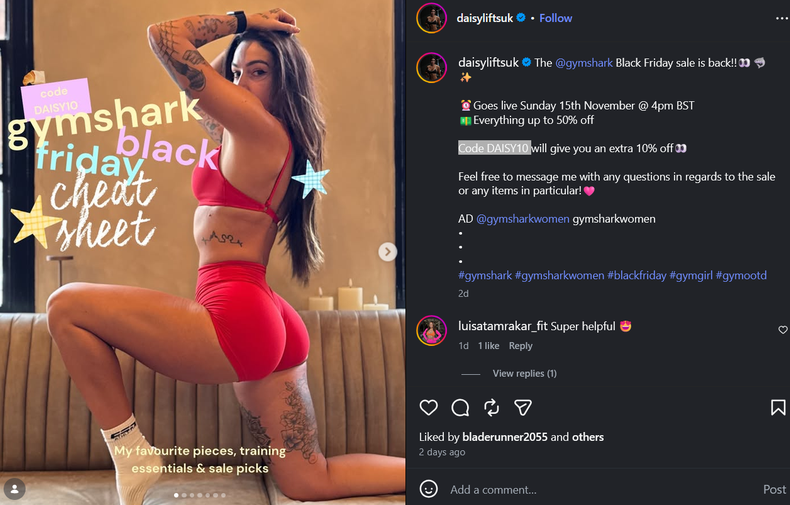
Here’s UK fitness micro-influencer Daisy Lee (89,000 Instagram followers), for example, promoting Gymshark’s Black Friday sale:
Stats speak for themselves:
- Influencer marketing returns an average of $5.78 (£4.35) for every $1 (£0.75) spent.
- Nearly 40% of UK brands call influencer marketing a core growth driver.
- Almost half of all consumers make purchases at least monthly because of influencer posts.
- A 2023 survey indicated that 84% of UK Gen Z and over two-thirds of millennials followed influencers.
- About 66% of marketers expect influencer campaigns to pay for themselves within a month.
That’s all well and good. But understanding why influencer marketing is so effective may be more persuasive than pure facts and figures.
Trust and authenticity
Influencers forge strong connections with followers, engendering relatability and trust. Compared against traditional ads, recommendations feel more authentic and trustworthy, as if from a friend.
“Influencer marketing is successful because it breeds a whole new realm of human-to-human connection and innovative brand creativity,” Sherri Nourse, co-founder of Ambition Media, told Forbes. “[People] are naturally inclined to follow and are persuaded by peers having social gravitas exemplified by social proof – followers, likes, and shares.”
Precise audience targeting
Influencers unknown to the general public may be prominent figures among, say, Londoners focused on sustainable fashion or Gen Z gamers hooked on Valorant. Collaborating with influencers relevant to your brand provides targeted engagement with such core demographics, promoting products directly to those most interested.
Engagement
Creator content organically fits into social media feeds and drives direct interactions in the form of likes, comments, shares, and saves. Those interactions – often prompted by social-savvy influencers through relevant CTAs (calls to action) – can build connections with your brand and a strong community of devoted consumers.
Clear goals
What are you trying to achieve? Whether your primary goal is sales, awareness, engagement, or something else, it’s a good idea to define your objectives and identify the best key performance indicators (KPIs) to track results.
Audience analysis
Who are you trying to reach? Determine the demographics of your target audience (age, gender, location, etc.). Identify their preferred social media platforms, and perhaps even try to gauge which creators they already trust.
Campaign type and budget
How will you interact with and reward creators? You may pay them to post, give them free products, make them affiliates or ambassadors, and so on. Setting a fixed budget will help you determine the number and type of creators to contact.
Creator selection
Who is worth partnering with? In general, larger influencers bring authority and visibility while smaller ones offer high engagement and more targeted communities.
Also consider:
- Engagement rates from their previous campaigns
- Follower growth history
- Audience demographics
- Comment quality
- Values and identity
Creative briefing
What should creators do or say? Create clear guidelines, including key talking points, compliance rules, payment terms, and timelines, but grant enough creative freedom for creators to stay natural and authentic.
Analytics
How did the content perform? Track relevant KPIs to determine the effectiveness of your campaign and how future marketing can improve or expand upon results.
Increased brand awareness
Influencer content is leveraged to reach as much of your target audience as possible, bringing them to the top of your sales funnel. Content tends to focus on emotionally driven storytelling to convey a brand’s identity and values. Sponsored content and free gifts (with no obligation to post) are common formats.
Key metrics:
- Reach
- Impressions
- Views
- Follower growth
Example: Watch brand Daniel Wellington ran sponsored micro and nano influencer content across Instagram, creating over 20,000 brand mentions and achieving international recognition.
Stronger community
Influencer marketing can transform passive audiences into active ones willing to comment, share, like, save, and otherwise engage with content, creating deeper, more trusting relationships with your brand. Micro influencers and nano influencers are a natural choice thanks to their high engagement rates.
Key metrics:
- Engagement rate
- Total comments, likes, and shares
- Comment quality
- Follower growth
Example: Bluehouse Salmon sourced food-based micro influencers to develop recipes and promote their sustainability. Followers increased 1,900% over 12 months, with one campaign yielding over 3,000 engagements.
Strengthened reputation
Partnering with influencers who represent how you want to be seen can redefine, rehabilitate, or simply broadcast your brand’s reputation. Long-term influencer ambassador programs are particularly effective at building trust and aligning values.
Key metrics:
- Approval ratings
Example: Grocery chain Iceland replaced traditional big-name ambassadors like Kerry Katona and Peter Andre with influencers from UK vlogger mum network Channel Mum, raising approval rates among mums from 10% to 80%.
Conversions and sales
Creators can promote products and services in return for a commission on sales made through tracked links or discount codes (otherwise known as affiliate marketing) – think YouTubers pausing to extol the virtues of NordVPN and offer a discount code. That type of marketing tends to include direct CTAs and seem more like standard ads. It can be great for measurable ROI/ROA.
Key metrics:
- Click-through rates
- Promo code redemptions
- Affiliate link purchases
Example: Olipop’s creator affiliate program used gifted products and performance-based commissions to recruit 1,900 micro, midtier, and major creators for a reported 982% average annual ROA. Micro influencers grew from 3% to 20% of creator-driven sales over three years.
Organic UGC
UGC (user-generated content) is created by regular social media users without being requested or paid for by brands or marketers. Post a picture of yourself posing with a designer handbag because you love the product, and that’s UGC. From a brand’s perspective, it’s great free advertising that can be reused for future marketing (with the poster’s permission, of course).
Creators can produce seemingly organic UGC, but influencer campaigns may prompt it naturally.
Key Metrics:
- Number of UGC videos or posts
Example: e.l.f. Cosmetics’ #EyesLipsFace campaign created an original song and TikTok challenge, used TikTok influencers like Brittany Tomlinson to kick things off, and became the most viral campaign in TikTok US history with 5 million user-generated videos.