Here are two things you already know:
- Influencer marketing has become a favoured brand strategy.
- Knowing how to find the right influencers for your brand may be tricky.
There’s just so many of them – a genuine glut that creates what can seem like a “sea of sameness,” making it hard to differentiate between what one potential partnership could bring and the next.
Yet 48% of marketers surveyed by Influencer Marketing Hub cite finding ideal influencers as their biggest challenge. Despite influencers being seemingly everywhere, it can seem like not a single one of them fits.
It’s time to separate the wheat from the chaff by learning:
- Where to conduct your influencer search
- How to choose the right influencers for your brand
- How to avoid undeserving (and potentially toxic) partnerships
JUMP TO
1. Manually searching on social media platforms
Consider this your getting-down-in-the-trenches approach. Each platform’s search engine and discovery tools work just as well for brands seeking influencers as users seeking content.
Try searching via hashtags or keywords.
Hashtags
Designed to categorise content and improve searchability, hashtags can be roughly broken down into:
- Content-specific (such as #grwm)
- Niche-specific (such as #healthyeating)
- Community-specific (such as #bookstagram)
- Location-specific (such as #london)
- Credential- or role-specific (such as #dermatologist or #workingmums)
Searching hashtags relevant to your industry and goals should harvest copious contenders. You may also add #sponsored or #ad to target influencers who are already working with brands.
Keywords
These are more natural and conversational phrases that mirror search terms customers use.
- Creators: How influencers describe themselves, such as “skin-care expert” or “London-based sustainable shopper.”
- Content: Terms that appear in captions, titles, and transcripts, such as “top five skin-care brands” or “how to shop sustainably in London.”
2. Online marketplaces
More targeted and less time-consuming than searching manually, online platforms connect brands looking for influencers with influencers hoping to partner. Talent pools are smaller since not every influencer is going to sign up, but that can be something of a relief.
Further benefits include:
- Filtered searching: Filter by location, gender, age, skills, niches, platforms, and content format, such as sponsored posts or user-generated content (UGC).
- Portfolios: See previous clients and view existing work.
- Availability: Find only influencers currently accepting brand deals.
Take this profile as an example:
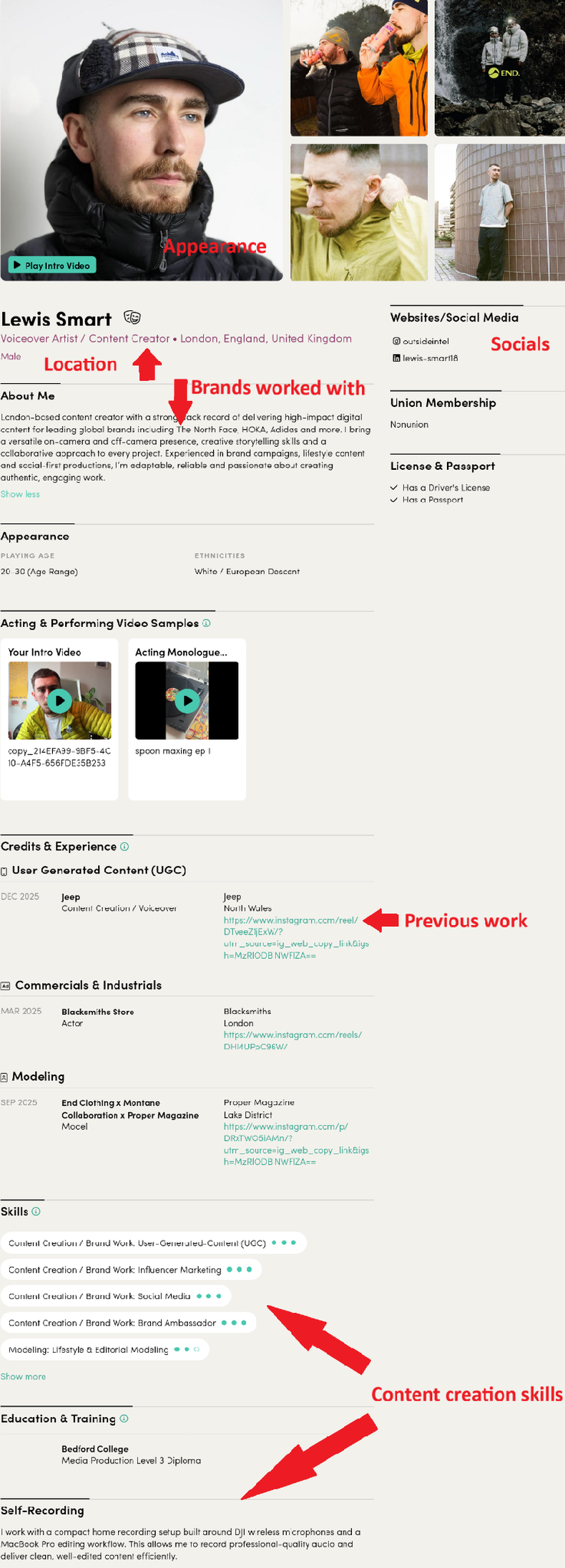
Alternatively, talent sites allow you to put the shoe on the other foot by posting jobs and bringing influencers to you.
Sure, but they’re generally more time-consuming with hit-or-miss results. You may also find influencers in the UK by:
- Exploring who competitors work with, bearing in mind that many will have signed agreements not to work with similar brands
- Asking trusted customers which influencers they like
- Attending relevant industry events to form in-person connections
- Checking your top followers for influencers already interested in your brand
- Finding customers already producing UGC for your brand or in your industry
1. Brand, know thyself
The better you know your brand, the better chance you stand of finding the right influencer to partner with. After all, how can an influencer fit before you know what they’re fitting?
Help this happen by setting your objectives and building an ideal customer profile.
Setting your objectives
Are you looking to drive conversions or improve visibility? In other words, what are you actually trying to achieve?
Common goals include:
- Improving brand awareness
- Gaining followers
- Increasing social media engagement
- Generating traffic to a company website or sales page
- Generating sales through discount codes or affiliate links
Building an ideal customer profile
Determine the target market for your influencer marketing campaign by considering:
- Age
- Gender
- Education
- Occupation
- Income
- Location
- Interests
- Values
- Preferred platforms
2. Filter down potential influencers
When compiling your shortlist of talent to approach, you should consider a multitude of factors.
What’s their main niche?
Naturally, you’ll want to team with influencers in or adjacent to your own niche.
A vegan food brand, for example, will align with a vegan cooking influencer, but may also consider someone like a sustainability influencer to reinforce their eco-friendly credentials.
Where are they most active?
The most effective platform should be where target audiences are most active. If one platform aligns with your branding, campaign goals, and audience more than the rest, finding influencers who are most active on that platform makes sense.
Here are some factors worth considering:
YouTube influencers
- Top platform for product reviews and information
- Popular across generations
- Ideal for in-depth product reviews and tutorials, especially for big-ticket products over £75 and continued conversions over time
Instagram influencers
- 63% of users are 18 to 34
- Instagram Shopping allows product discovery and buying within the same platform
- Nano-influencers (under 10,000 followers) are especially valuable
- Ideal for fashion, beauty, home décor, and lifestyle brands
TikTok influencers
- 53% of users are 18 to 24 and 27% are under 18
- Leveraged by 49% of Gen Z users for product discovery
- Lifestyle is the most popular influencer marketing category (130 billion engagements), followed by beauty (50.9 billion) and fashion (36.7 billion)
- Ideal for creating trends and reaching larger audiences through smaller influencers
Facebook influencers
- Core demographic of working professionals and young parents
- Favourite platform of users over 65
- Users respond to demos, before-and-afters, and customer feedback stories that save time or money and solve problems
- Ideal for lifestyle, fitness, and family-oriented brands
How big is their following?
Don’t fixate on follower count. Bigger isn’t always better. Depending on your goals, partnering with several smaller influencers could prove far more effective than landing a single big name.
- Nano influencers (under 10,000 followers): They charge the least, while delivering the highest engagement rates and targeting niche interests. They’re great for hyper-targeted locations and niches, or building strong connections with potential customers.
- Micro influencers (10,000 to 100,000 followers): They generally bring more experience and marketing savvy. They’re often considered minor experts within their niche, and they can be great for product launches and conversions.
- Midtier influencers (50,000 to 500,000 followers): They have more reach and authority than micros and nanos while maintaining engaged communities. Great for a blend of exposure and engagement.
- Macro influencers (500,000 to 1 million followers): They offer brands wide reach and credibility by association. Great for building awareness.
- Mega influencers (over 1 million followers): They have massive reach and trendsetting reputation beyond their chosen niche, but with relatively low engagement. Great for major launches and cultural moments.
How engaged is their audience?
Engagements show active interactions – think likes, comments, shares, reactions, and saves. Views are nice for gaining exposure, but engagements demonstrate a genuine ability to influence a user’s actions, whether it’s responding to comments or clicking links.
That’s why engagement rate is such an important metric. Here’s the formula: (total engagement/total followers) x 100 = engagement rate.
Different platforms deliver different engagement averages, too, which are as follows, according to Buffer:
- LinkedIn: 6.2%
- Facebook: 5.6%
- Instagram: 5.5%
- TikTok: 4.6%
Unless you’re prioritising exposure, influencers with strong engagement should be your go-to.
How often (and what) do they post?
Acknowledging cadences and content type can be helpful, and it’s wise to proceed cautiously when you notice gaps in upload schedules or long-dormant profiles.
“Influencers who post consistently tend to maintain higher engagement rates and keep their audiences active,” according to Influencer Hero.
Next, check their ratio of sponsored vs. organic content. Some previous partnerships will help prove their professionalism and experience, but a surfeit suggests they’re undiscerning and that credibility with followers may have taken a hit.
Who is their audience?
Influencers may (and should!) cover demographics in their media packs. If not, several dedicated analytics platforms let you take a peek behind the curtain.
Options include:
“Ensure the influencer’s audience demographics align with your target market,” Peter Nettesheim writes for Influencer Hero. “Age, location, interests, and gender are key factors to consider.”
How’s their past performance?
Give past sponsored posts a once-over while asking questions such as:
- Does engagement drop off?
- Do followers complain they’re shilling?
- Do audiences resonate with sponsors?
- How organically are sponsorships woven into the content?
Deeper analytics can be gleaned from influencer media kits or requested during influencer outreach.
Key metrics include:
- Click-throughs
- Views
- Watch time
- Engagements
- Referral traffic
- Conversion rates
- Promo redemptions
- Affiliate link clicks
- Brand’s follower growth
How does their vibe align with yours?
An influencer who ticks every box in theory may miss the mark by failing to jive with your brand identity. On the flip side, it’s also why an influencer only tangentially related to your niche may hit the right note purely based on their personality.
You may feel it on instinct, but, if you don’t, try summing up your brand or upcoming campaign in three words. Then consider which influencers also fit those words.
Consider:
- Personality and energy
- Style
- Aesthetics
- Values
Modash found the No. 1 problem among influencer marketers was finding only “low-quality creators, with low engagement rate, poor audience fit, or an overall spammy look and feel.”
“A lot of companies just simply work with the wrong people,” influencer marketing expert Neal Schaffer summed up on The Pam Didner Show.
Here are three red flags:
1. Bought views and comments
An estimated 11% of influencer-sponsored Instagram post engagements come from fraudulent accounts. Basically, views and engagements were bought. Thus, bogus.
Common signs include:
- Abnormal spike in followers or views
- Large follower count but low engagement
- Commenters coming mainly from a different country
- Multiple comments filled with emojis, generic compliments, or grammatical errors
- Multiple comments unrelated to the post
2. Inflammatory content
“Due diligence should extend into historical research,” Dale Barnett writes for Influencer Intelligence. “Influencers who have put out offensive or harmful content that clashes with the ethos or viewpoint of the brand should not be approached.”
3. Undisclosed ads
Influencers are legally required to disclose whenever they’ve “been incentivised in any way to promote a brand or product.”
A single lapse or two? Understandable, but influencers you notice routinely failing to disclose ads could be trouble. Repeat offenders may even appear on the Advertising Standards Authority’s (ASA) list of noncompliant social media influencers.
It’s best to find influencers who play by the rules.