All acting is reacting, as the old adage goes. And nowhere is that more true than when it comes to creating chemistry with a co-star.
“Chemistry” is an amorphous term – it can be hard to pinpoint what exactly contributes to great chemistry, but we know it when we see it. When two leads have real chemistry, it crackles off the stage or screen. We believe the people fancy each other, or are best friends, or have devoted parent-child love.
Chemistry is about what happens when two separate ingredients – the actors – come together, and what new energy is created between them. It can be hard to predict though – hence the chemistry read. A chemistry read is a specific part of the audition process, during which casting directors and the creative team of a show or movie can check that the leads they have in mind work well together and have a natural spark.
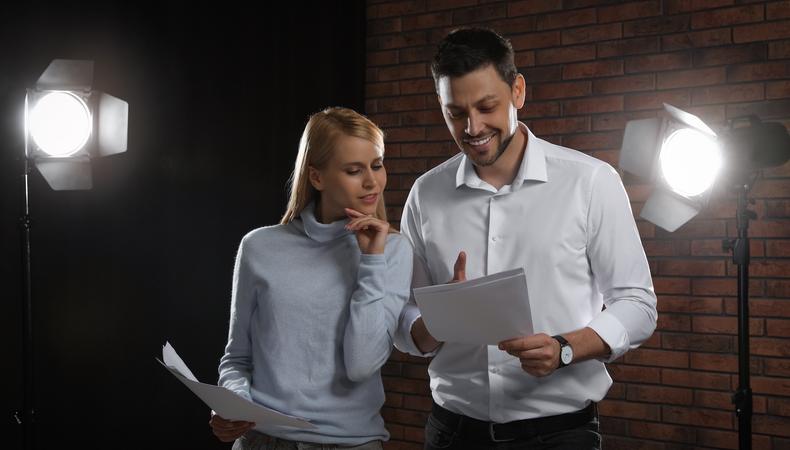
A chemistry read will follow an initial audition, during which they determine if an individual actor is right for the role. Rather than a straightforward table read, which is about hearing the words of the script and getting a feel for pacing with the whole cast, a chemistry read will likely be one on one and may be more embodied. It’s about how the actors respond to each other, if they feel like a good fit, and how they move and look together. Traditionally, chemistry reads were done in person, but these days they’re sometimes done online. That can be more challenging when it comes to fostering a connection with a co-star you’ve never met.
When actors have a real connection, casting teams often feel it immediately – and trust that audiences will too. They’ll be more likely to swiftly invest in a series or fall in love with a movie. Consider the casting of mega hit Heated Rivalry. Its creator, Jacob Tierney, recounted the reaction of star Hudson Williams when he read with Connor Storrie, the third actor with whom he had a chemistry read. “Hudson told me, ‘The other guy was good, but Connor felt like he was going to pin me down and fuck me’ … And I was like, ‘Well, I think I cast this right.’”
Hudson also described that instant connection as being “an inexplicable X-factor” – and many actors, directors, and casting directors will acknowledge that, despite the name, chemistry reads are about instinct and luck rather than being an exact science. According to Linda Lowy, a legendary casting director who worked on Grey’s Anatomy and Scandal, chemistry cannot be quantified – and any casting director worth their salt knows it. Nonetheless, there are things you can do as an aspiring actor to put yourself in the best possible position for if you get that callback.
Casting directors want actors who are flexible, responsive, and nimble. A chemistry read is not a chance to show off your individual acting chops; it’s more about showing that you can listen to and really hear the other person, respond to their energy, and build something new together. Allow their choices or line readings to influence yours; don’t stick rigidly to how you’ve decided a scene should go. And be generous! Helping the other actor to shine only makes you look good too.
“It is chemical, but it’s also the work,” says casting director Caroline Liem of successful auditions, adding that the actors who she casts are those who are “actively getting (or fighting) for what they wanted from the other…like any strong relationship, each made the other look better and be better.”
Don’t rush it. “Allow each moment or beat to breathe – to connect truthfully – before moving on,” Liem says. That’s good advice for all auditions, but it can be particularly pertinent for a chemistry read. Allow lines to land, really hear the other person, and don’t be afraid of a held pause – after all, those spaces are often where tension builds, whether it’s emotional, sexual, or dangerous. Trust the silence; it can speak volumes if you let it.
Any actor should be physically responding to their co-stars, but proving you can bounce off your opposite number is particularly crucial in a chemistry read. Eye contact is essential. Whether it’s a romantic, rivalrous, sexy, or stormy relationship, huge emotion can be conveyed through eye contact. Plus it’s a vital (and handy) shortcut for quickly connecting with your co-star in the moment, helping you to be able to anticipate where they’re trying to take the scene next.
You also need to be hyper aware of your body language and theirs, as well as how you speak the lines. You and your co-star may decide to convey two very different stories with what you say and how you perform.
In an early read, you should also not be afraid to show up as yourself. “We’re definitely casting the human as well [as the part],” Lowy says. “You have the character on the page, and you have the actor in front of you. And what happens is that thing in between, and that is the light.” Her most common piece of advice or direction to actors: “‘I like what you did, but do it again – and be more yourself.’ I have that person in the room because I need something they have to embody this character, to fill up the page with their own personality. That’s a huge part of it.”
You can never control whether you’ll have that mysterious connection with a fellow actor, but you can help your chances by creating the conditions in which instant sparks can fly.
The thing you should do for any audition – memorise your lines – is even more important for a chemistry read. It’s hard to maintain smouldering eye contact when you’re scanning a page, or to get truly comfortable with another person with a script in your hand. Learning your part in advance will allow you to be more playful, flexible, and reactive in the room, whether it’s responding to the other actor’s choices or taking direction from the casting and creative teams.
On the day, you should also make sure you’re in the most calm but open state possible – ready to meet and truly connect with the other performer. Make sure you’ve done a physical warmup, since body language is so crucial, and consider finding a short series of breathing exercises that can become part of your routine to help calm your nerves, improve your focus, and ground you in your body.
Make sure you wear something that feels in line with your character but isn’t too restrictive, so you can still move easily. If it’s a virtual chemistry check, make sure your tech setup is as supportive and flattering as it can be. Ensure that your internet connection is solid, your lighting is bright and clear, and your framing is appropriate. (You want to have your head and shoulders in the shot, but not much more or you risk losing a sense of intimacy.)
As an actor, there are also exercises you can do regularly or in advance of getting that chemistry call-back, so you know you’re tuned up and ready to go.
Buddy up with fellow aspiring actors to practise honing your skills. Perform scenes together and play around with different line reads and responses. Try simple physical mirroring exercises, in which you match one another’s movements, to develop awareness of body language. Explore eye-contact exercises to get used to the (sometimes uncomfortable!) sensation of holding the gaze of someone you don’t know well. Practise performing short scenes on video calls so you can get a feel for how chemistry reads online are different from in-person sessions and learn how to react to common pitfalls, such as timing lags, limiting frames, and connection errors, without getting flustered or panicked in the moment.
And remember to approach all of this with a sense of play – something casting directors are often on the lookout for, especially for roles in which responding organically to another character is key.
As Liem puts it, getting to see true collaboration in an audition room is “much more fun.”