Choosing the right audition monologue — and mastering it — could be a key ingredient in landing your next role.
Having an armoury of both classical and contemporary monologues to perform on demand can demonstrate your command of bringing a text to life, your versatility, and your characterisation skills, helping you nab that coveted drama school place, agency representation, or professional acting job.
If you are a male actor or aspiring to be one, you’ll want to select monologues for men that fit your casting, that you can identify with, and which differ in tone, style, and subject matter.
Often you will be asked to perform at least one classical and one contemporary monologue for an audition, so it’s important to be ready, with a couple of them prepared before each casting call you attend.
Looking for inspiration? Browse our selection of engaging monologues for guys, spanning theatre, film, and TV, as well as classic, modern, and contemporary speeches.
Of course, while the characters in these monologues are written as male, this does not restrict who can play them.
The Cherry Orchard (1903), written by Anton Chekhov
Character: Peter Trofimov
Context: Widely regarded as a classic of 20th century theatre, the play centres around an aristocratic Russian landowner returning to her family estate before it is auctioned to pay the mortgage. The story examines attempts for the aristocracy to maintain its status in society, and for the bourgeoisie to adjust to and find meaning in its new material elevation.
Why choose it? Speeches by Peter Trofimov, a student, are often considered great audition monologues for men because they are passionate, philosophical, and full of ideas to promote social change. They allow the actor to demonstrate emotional versatility and an ability to convey complex ideas.
TROFIMOV: Man goes forward, perfecting his skills. Everything that is now beyond his reach will one day become near and comprehensible, only we must work, we must with all our strength help those who are seeking the truth. In Russia as yet we have very few who do work. They call themselves intelligentsia, but they’re rude to servants, they treat peasants like animals, they are poor students, they read nothing seriously, they don’t do a thing, they just talk about science, they understand little about art. They’re all serious, significant, they talk philosophy, but meanwhile in front of their eyes the workers eat disgusting food, sleep without pillows, thirsty… And of course all our fine conversations are just to divert our own and others’ attention. Show me where we have creches, which are talked about so much and so often, where are the reading rooms? They’re just written about in novels, in fact they don’t exist at all. There’s only dirt, smallness of spirit, just Asia… I fear and dislike very serious expressions, I’m frightened of serious conversations. Better to be silent!
Art (1994), written by Yasmina Reza
Character: Marc
Context: Three male friends – Serge, Yvan, and Marc – meet, and after one buys an expensive modern painting that is, in fact, a white canvas with fine white diagonal scars, another finds this ludicrous, and the third tries to placate both sides. Through their discussions, the play explores whether we are who we think we are, or who our friends think we are.
Why choose it? Art was a hit play of the 1990s. It is highly accessible and often amusing, with a killer central idea (what’s the worth of a white canvas?) questioning the meaning and value of art. This excerpt, set at Serge’s home, encapsulates the essence of the play. You’ll be able to demonstrate how you can deal with pauses and exclamations, a bit of tricky sentence structure, and French pronunciation of names, while also having the chance to showcase your comedic skills to raise a laugh or two.
MARC: It’s a complete mystery to me, Serge buying this painting. It’s unsettled me, it’s filled me with some indefinable unease.
When I left his place, I had to take three capsules of Gelsemium 9X which Paula recommended - Gelsemium or Ignatia, she said, Gelsemium or Ignatia, which do you prefer, I mean, how the hell should I know? - because I couldn’t begin to understand how Serge, my friend, could have bought that picture.
Two hundred thousand francs!
He’s comfortably off, but he’s hardly rolling in money.
Comfortable, no more, just comfortable. And he spends two hundred grand on a white painting.
I must go and see Yvan, he’s a friend of ours, I have to discuss this with Yvan. Mind you, Yvan’s a very tolerant bloke, which of course, when it comes to relationships, is the worst thing you can be.
Yvan’s very tolerant because he couldn’t care less.
If Yvan tolerates the fact that Serge has spent two hundred grand on some piece of white shit, it’s because he couldn’t care less Serge.
Obviously.
Jumpy (2011), written by April De Angelis
Character: Roland
Context: This play deals with a common generational conflict – the relationship between mother and daughter. The mother, Hilary, is preoccupied with various issues, from gender bias in children’s toys to the objectification of the female body, while navigating coming to terms with a life after 50. Her daughter, Tilly, is in the midst of teenage rebellion, with sex, drugs, alcohol, pregnancy, and angst all in the mix.
Why choose it? This is a frank and funny play questioning parental anxieties. In this monologue in Scene 7, jaded parent Roland is talking to Hilary, reflecting upon teenagers’ friends being their whole world and when parenting can be disillusioning. It’s very naturalistic and an opportunity for a male actor to convey a convincing and believable character in modern Britain.
ROLAND: They move in packs. Day and night - every minute they want to be with each other. Can you imagine wanting to spend that much time with other people? I mean a few drinks, lunch, an evening. But every minute of the day? Phoning, eating, sleeping at each other’s houses, they can’t get enough. What happens to us that we grow so un-enamoured of each other? People turn your stomach, don’t they? Their fucking issues and their vanity.
One minute there’s the nappies, the Calpol, their inconvenient sicknesses, reading them the same story till it’s tattooed on the back of your eyelids - though Bea did that mainly - you can’t wait for them to go to sleep at night so you can get in a few glasses of wine - then this redundancy. How does that happen?
The Godfather (1972), screenplay by Mario Puzo and Francis Ford Coppola
Character: Luca Brasi
Context: Based on Puzo’s novel of the same name, The Godfather is widely seen as one of the greatest films of all time. With its focus on Mafia power plays, this is about as traditionally masculine a film as you can get. The screenplay is of the highest order, and even minor characters have rich, memorable monologues.
Why choose it? Though it’s not the longest monologue, so much is crammed into this speech. Luca Brasi visits Don Vito Corleone, aka the Godfather, at his daughter’s wedding to pay his respects. Despite Brasi being the Godfather’s most feared mob enforcer, his fear at meeting the boss makes this scene one of the funniest in the whole film. To carry that off in such a consistently chilling script is no mean feat. An actor being able to convincingly convey, simultaneously, the menace and the humour would invariably result in an unforgettable audition piece.
LUCA BRASI:
(rehearsing his lines aloud)
Don Corleone, I am honoured and grateful that you have invited me to your home on the wedding day of your daughter. And may their first child be a masculine child.
(he starts the lines again)
Don, Don Corleone...
(he strides over to address the Godfather, Don Corleone)
Don Corleone, I am honoured and grateful that you have invited me to your daugh…ter’s wedding...
(he falters, realising that he has messed up his rehearsed lines)
...on the day of your daughter’s wedding. And I hope that their first child be a masculine child. I pledge my ever-ending loyalty.
(Luca hands Don Corleone a cash-filled envelope)
For your daughter’s bridal purse.
Don Corleone, I am going to leave you now, because I know that you are busy.
Dead Poets Society (1989), written by Tom Schulman
Character: Mr. Keating
Context: This film features a group of boarding school students whose new poetry teacher shows them how to rebel against the status quo and find deeper meaning in life.
Why choose it? The film’s “seize the day” monologue is very famous, so here’s a lesser known option. It’s a good idea to choose monologues to perform that aren’t so popular that they have almost overstayed their welcome. Another reason? The better known the monologue, the more likely the casting director may compare your performance with that of a famous one. This excerpt is full of passion, and to perform it satisfyingly, without overdoing things, makes for an effective audition piece.
MR. KEATING: In my class, you will learn to think for yourselves again. You will learn to savour words and language. No matter what anybody tells you, words and ideas can change the world. I see that look in Mr Pitts’ eye, like 19th century literature has nothing to do with going to business school or medical school, right? Maybe. Mr Harkins, you may agree with his thinking: yes, we should simply study our Mr Pritchard and learn our rhyme and meter and go quietly about the business of achieving other ambitions. Well, I have a little secret for you. Huddle up. Huddle up! We don’t read and write poetry because it’s cute. We read and write poetry because we are members of the human race. And the human race is filled with passion. Medicine, law, business, engineering, these are noble pursuits, and necessary to sustain life. But poetry, beauty, romance, love, these are what we stay alive for. To quote from Whitman: “Oh me, Oh life of the questions of these recurring. Of the endless trains of the faithless, of cities filled with the foolish. What good amid these? Oh me, Oh life. Answer: that you are here. That life exists, and identity. That the powerful play goes on and you may contribute a verse… That the powerful play goes on and you may contribute a verse.” What will your verse be?
Black Hawk Down (2001), screenplay by Ken Nolan
Character: Sgt Eversmann
Context: This film is about an elite force of American soldiers on a mission to seize a Somalian warlord’s top lieutenants, but who find themselves ambushed by a group of heavily armed Somalis instead. In this monologue, Sgt Eversmann mourns his fallen comrade, Cpl Jamie Smith.
Why choose it? Black Hawk Down really shows the brutality of war, without glorifying it, and feels believable. It focuses on the intense close-quarters fighting experienced by American soldiers. Performing this speech with all this in mind is an opportunity to demonstrate fierce acting skills.
SGT EVERSMANN: I was talking to Blackburn the other day, and he asked me, you know, what changed? Why are we going home? And I said, “Nothing.” That’s not true, you know. I think everything’s changed. I know I’ve changed. You know, a friend of mine asked me, before I got here, just right when we were all shipping out, he asked me, “Why are you going to fight somebody else’s war? What do you all think, you’re heroes?” I didn’t know what to say at the time, but...if he asked me again, I’d say no. I’d say, there’s no way in hell. Because nobody asks to be a hero. It just sometimes turns out that way. I’m gonna talk to your ma and pa when I get home, OK?
Talking Heads: A Chip in the Sugar (1988), written by Alan Bennett
Character: Graham Whittaker
Context: Graham, a repressed homosexual man with a history of mild mental health problems, is dealing with jealousy when his mother, with whom he still lives, reunites with an old flame.
Why choose it? If you’re looking for a relatable monologue to perform, you can’t do much better than Bennett’s classic collection of them, under the series’ umbrella title Talking Heads. Exploring the human condition with empathy, these monologues pack in humour and sorrow, using a delectable, specific, and very English language that theatre, film, and TV director Richard Eyre has aptly described as “droll, sharp, overheard, and unexpected.”
GRAHAM: I’d just taken her tea up this morning when she said, “Graham, I think the world of you.” I said, “I think the world of you.” And she said, “That’s all right then.” I said, “What’s brought this on?” She said, “Nothing. This tea looks strong. Pull the curtains.” Of course I knew what had brought it on. She said, “I wouldn’t like you to think that you’re not number one.” I said, “Well, you’re number one with me, too. Give me your teeth. I’ll swill them.”
What it was, we had a spot of excitement yesterday: We ran into a bit of Mother’s past. I said to her, “I didn’t know you had a past. I thought I was your past.” She said, “You?” I said, “Well, we go back a long way. How does he fit in vis-a-vis Dad?” She said, “Oh, he was pre-Dad.” I said “Pre-Dad? I’m surprised you remember him; you don’t remember to switch your blanket off.” She said, “Oh, that’s different. His name’s Turnbull.” I said, “I know. He said.”
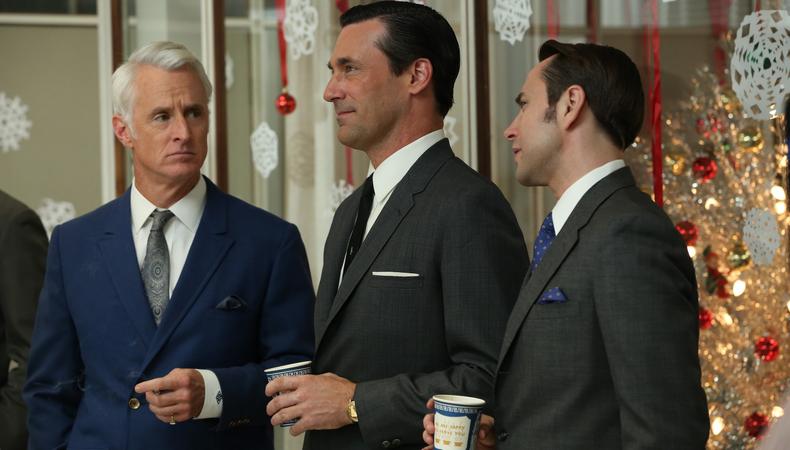
Mad Men (2007), written by Matthew Weiner and Robin Veith
Character: Don Draper
Context: Set in the 1960s, this exceptional television series features Don Draper, a creative director at Sterling Cooper in New York, attempting to maintain a balance between his impressive professional and troubling personal lives. This monologue is from Season 1, Episode 13 (The Wheel), when Don pitches a new product, the Kodak Carousel.
Why choose it? Mad Men has many great monologues, but this Kodak Carousel pitch has a poignant take on nostalgia. It’s a powerful speech underlining the essence of the series, taking hold of people’s emotions to sell things.
DON: Well, technology is a glittering lure, but there’s the rare occasion when the public can be engaged on a level beyond flash, if they have a sentimental bond with the product. My first job, I was in-house at a fur company with this old pro copywriter. Greek, named Teddy. And Teddy told me the most important idea in advertising is “new.”
Creates an itch. You simply put your product in there as a kind of calamine lotion. But he also talked about a deeper bond with the product: nostalgia. It’s delicate… but potent. Teddy told me that in Greek, “nostalgia” literally means “the pain from an old wound.”
It’s a twinge in your heart. Far more powerful than memory alone. This device isn’t a spaceship. It’s a time machine. It goes backwards, and forwards. Takes us to a place where we ache to go again. It’s not called the wheel. It’s called the carousel. It lets us travel the way a child travels, around and around and back home again to a place where we know we are loved.
Ridley Road (2021), written by Sarah Solemani
Character: Soly Malinovsky
Context: Ridley Road is the story of the Jewish-led, anti-fascist 62 Group that stood up against the rising neo-Nazi movement in Britain after World War II. The four-part series is based on Jo Bloom’s book of the same name. Soly is a hot-headed cab driver and the leader of the 62 Group. This excerpt is from Episode 1.
Why choose it? This well-crafted story with compelling characters feels both relevant and entertaining, especially because of its timely exploration of extremism in modern society.
SOLY: How bad can it get? Her dad used to say. How bad can it really get? Even when the German officials came to their town... They took rooms with Jewish families. Friendly as anything. One of them bought his Jewish landlady a box of chocolates. “See? It’s not so bad.” Her dad said. “Where is this cruelty you speak of?” “They’re not going to take us away from our homes, this is our country. What a ridiculous...paranoid...notion.”
When the German vans came, they parked outside their house and stayed there for two weeks. Two weeks. They waved and said hello. They learnt their names. He leans in. Then within 20 minutes they were rounded up, in the dead of the night. Everything seems absolutely fine, Vivien. Until the moment it isn’t. And then it’s just too late.
He’s got important work to do, Vivien. Forget about him. Move on. Stay out the way, darling. Your old man’s gonna meet you at Manchester station tomorrow, the 9:15 from Euston. So you won’t mind packing up and saying your nightie nights? Make sure to give your mother my best.