The concept of dieting has existed since ancient Greece. Probably the most infamous model diet popularised by Vogue was the wine and eggs diet, published in 1977. That story seems amusing today, but it actually hides within it some persistent and dangerous assumptions about what models eat – notably that they don’t eat carbs or fats, and that they practically starve themselves.
Thankfully ideas around what constitutes a healthy diet – and wellness generally – have come a long way since then. Even so, models and their diets have a certain reputation for being extreme. Why is that? And what does it mean for someone hoping to become a model or get scouted, especially if they’re well beyond their teenage years?
Here are some common model diet myths debunked. Plus, what models really eat, how they keep fit, and what they have to say about their diets.
JUMP TO
Models existed before the 1980s (hello, Twiggy), but the 1980s were a turning point in fashion when models became “supermodels” – cultural icons and household names whose influence extended well beyond the runway. The new pressure of being in the public eye meant that models' bodies were under even greater scrutiny from the press and the public.
According to Kirstie Clements, former editor of Vogue Australia, although the models of the 1980s were “naturally willowy and slim” they also “ate lunch – sparingly, for sure, but they ate.”
Even then, models were generally skinnier than the average woman (supermodel Cindy Crawford, for example, was a size 10 in the 1980s), but they were a far cry from the dangerously thin “heroin chic” style that began in the mid-1990s and continued into the noughties. The model diet during that later period was more about not eating, and models went to drastic measures to feel full without putting on weight.
An age-restriction law in 2007 saw under-16 models banned from walking in London Fashion Week in an attempt to protect younger girls from aspiring to the extreme model thinness that was expected at the time.
The 2010s saw a rise in demand for plus-size models, with major mainstream agencies such as Milk Management, Models1, and Storm Models opening dedicated curve divisions.
In the past few years, there are worrying signs of a return to dangerously skinny frames. The Vogue Business Inclusivity Report revealed that the spring/summer 2026 shows had the lowest proportion of plus-size, curve, and midsize models since the biannual report began in 2023.
That means model diets could be slipping back to the extreme end of the spectrum. Australian model Robyn Lawley referred to the Victoria’s Secret preshow diet as a “starvation-camp situation.” What’s more, the 2025 news about Miranda Kerr’s strict diet, masked as biohacking, is a worrying example of how wellness can be used to hold up unrealistic body ideals.
One of the highest-earning supermodels ever, Gisele Bündchen, has made her diet public since 2016. It’s made up of a mix of vegetables, whole grains, and lean meats. Former Victoria’s Secret Angel Lily Aldridge, meanwhile, swears by the Sakara meal-delivery diet; the company delivers plant-rich, whole-food, ready-to-eat meals, as well as supplements, to its customers.
Another diet used by models is the blood type diet (each blood type is given a different diet). Kerr followed the blood type A diet, which was shown in 2014 to lower BMI, waist circumference, blood pressure, cholesterol, and insulin. The type A diet is mostly vegetarian.
Even with a perfect diet, a model needs to prepare for low-energy moments. Ashley Graham likes to keep an 80 percent dark chocolate bar on standby to give her “the boost I need when I’m having an energy crash.” And it’s not just Graham. Many models swear by dark chocolate, too, such as Kelly Gale, Alessandra Ambrosio, and Abigail O’Neill.
Modelling is a physically and emotionally demanding job, so it’s important to consider your wellness holistically rather than simply count calories.
Time and again, models say how important it is to look after your mental health. Karlie Kloss meditates, Alva Claire writes in her journal, and Libby Bennett rates a good night’s sleep above everything else.
If you want to perform well as a model, it’s also crucial to stay hydrated. “Even mild dehydration can affect concentration, mood, energy, and physical performance,” says nutritionist Natasha Draycott.
Building a support network can also help you manage your model diet. Jacqui Hooper told Vogue that when you’re a model, “friendships give you a real sense of security and comfort.” It’s worth finding friends who understand the industry with whom you can share your problems, successes, and healthy eating tips.
Credit: sergey kolesnikov/Shutterstock
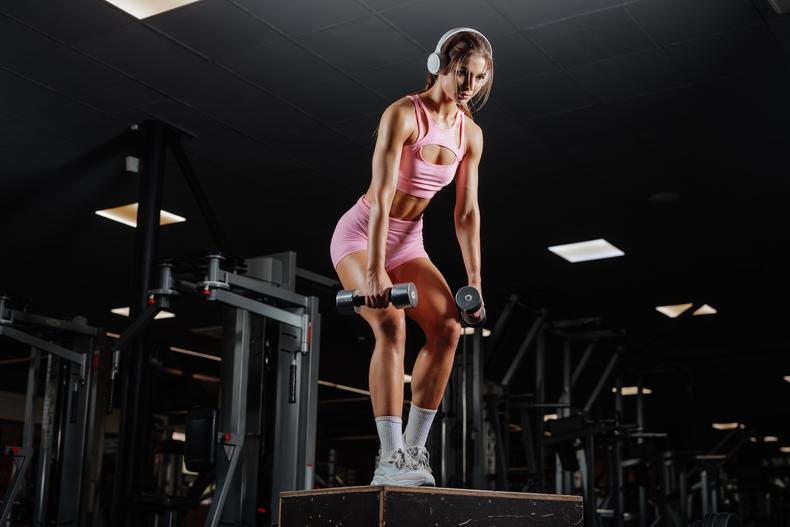
Everyone’s body is different, so model fitness routines look different depending on who you ask.
Karlie Kloss told Vogue she works hard to fit her exercise around a busy schedule of travel and shoots. When she does, she likes to “work out to really feel the strongest that I can.”
Alva Claire does Pilates and beginner yoga, and goes for long walks. “I listen carefully to my body and what it needs,” she told Vogue. “Wellness always starts in my mind.”
In terms of more scheduled model fitness routines, Victoria’s Secret model Lameka Fox keeps her body healthy and strong with three workouts a week, including interval training to stay toned.
Many models are naturally thin. “Most of us are naturally slim and don’t follow a raw cauliflower diet,” fashion model Ines Celine told the Guardian.
Models work out and try not to binge on junk food, of course, but they tend to already be a size that’s easy to maintain. Otherwise there’s no way models like Kate Moss, Naomi Campbell, or Adriana Lima would have sustained such lengthy careers.
That’s not to say there isn’t a pressure to drop weight from time to time. Which is why it’s essential to look after your mental health. There’s plenty of work out there for models of all sizes, so it’s more about having the self-confidence to believe in your abilities at the size you are. “You definitely go through times where you’re like, ‘Oh, maybe if I just lost so much weight, I’ll finally get this job,’ midsize model Celina Ralph told Vogue. “I think as long as I feel good and my mental health is good, everything will fall into place.”
Progress was made in the 2010s, but there is still a way to go – and the industry is circling back to the extreme thinness of the noughties. Even though larger sizes reflect the real population, plus-size models are still marginalised rather than the norm. “It’s disorientating to be part of an industry where I’m relegated to a corner for simply being a size 12,” plus-size model Paloma Elsesser told i-D.
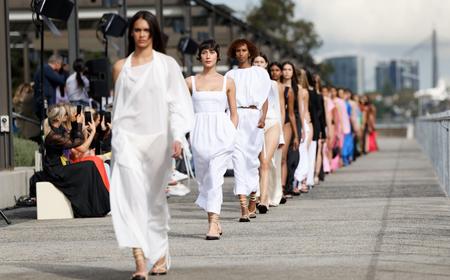
It’s not all doom and gloom; change is happening. Emerging designers are reintroducing body diversity at London Fashion Week. Designers such as Karoline Vitto, Phoebe English, and Sinead Gorey cast a wide size range for AW26, pushing back against the wider industry’s return to ultra-thin casting.
The most successful model diet isn’t about eating less – it’s about having the energy to live, work, and feel your best.