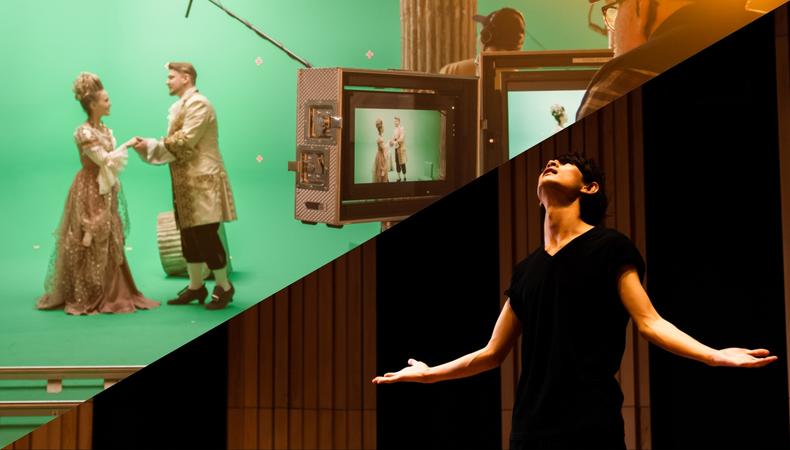
Few actors confine themselves to a career only in live theatre or only onscreen – and switching between the two can be stretching, rewarding, and financially prudent. But the two disciplines require very different kinds of performance, and, as an early career actor, it can be useful to know what to expect and how your craft may need to change.
Acting onstage and acting onscreen share lots of DNA, of course. In both, you start by analysing the script and working to build a believable character with a rich inner life. Whether on camera or onstage, it’s vital that you listen actively and respond authentically. Emotional honesty registers just as much under stage lights as it does through a lens.
If you’re transitioning from one medium to the other, you can expect a steep learning curve, but that learning will enrich your performance skills in both mediums. Theatre can build discipline and stamina, as well as an energetic responsiveness and sense of live presence. Screen develops subtlety, stillness, and emotional precision, as well as demanding an in-the-moment adaptability and openness to changing up your performance.
From the rehearsal process to the scale of your delivery, here’s a practical breakdown of what changes – and what stays the same – when moving between theatre and screen. Master both and you’ll be a more versatile, employable actor who’s ready for whatever job comes next – whether onstage or onscreen.
JUMP TO
Theatre is typically rehearsal‑heavy. You may spend weeks exploring the script, finding your character, figuring out how to bring stage directions to life, building trust and chemistry within the cast, and exploring different performance approaches. By opening night, the shape of the show is, in most cases, pretty locked down. The challenge then is to repeat it, night after night, with enough spontaneity that it feels alive in the moment and enough predictability that the whole on-stage company knows what they’re doing and feels secure.
Screen acting flips that model. Rehearsal time is often minimal or nonexistent. In most cases, you are expected to arrive ready, having done your character work independently. But be prepared for that work to fly out the window if it doesn’t fit the director’s vision on the day. A crucial part of a screen actor’s skill set is being able to change their performance very quickly in the moment based on direction. Figuring out different approaches to take in a play may happen over several weeks, but a screen actor may be required to do something different each take with only minutes to recalibrate their performance. Film acting, therefore, requires flexibility and adaptability to quickly take direction and deliver different emotions on demand.
In theatre, the story unfolds moment by moment, and usually chronologically. Some actors find the real-time experience satisfying to perform, because they’re able to feed off the momentum and emotional build. Each performance has a natural arc, from beginning to end, that helps drive the energy and experience of the characters onstage.
On screen, however, you may film the final scene on the first day and the opening moments weeks later. Continuity becomes a technical and emotional challenge. You must match energy, physicality, emotional intensity, and even eyelines across multiple takes and shooting days, and inhabit a character authentically and coherently when shooting from cold. An in-depth knowledge of the script and the character’s emotional arc through it – and also within each scene – becomes essential prep.
Theatre acting is a shared experience. The audience is right there with you, and you’ll be able to pick up on their reactions – for better or, sometimes, for worse! Stage actors are often highly attuned to an audience’s reaction: their laughter, their tears, an intake of breath – an actor can feel when they have their rapt attention or when they’re losing them. And an audience’s energy can be different each night, which will subtly shape each performance.
Screen acting removes the audience from the room. Instead, you’re building a relationship with the camera, an inanimate object that must stand in for the eventual viewer. The lack of immediate audience feedback can be hard for some actors to adjust to, but it’s essential to trust that connection with the camera and give it your all. Some performers even find it liberating. You don’t have to play to an audience, and you can give a smaller, more truthful and direct performance straight down the lens.
One of the most obvious differences between stage and screen acting is scale. In theatre, you could be performing in front of thousands of people and you always need to make sure you’re delivering your lines to the very back row. That doesn’t mean overacting, but it does mean your choices need to read clearly across distance. “This doesn’t mean that the actor has to shout and scream every line, but it does mean that there’s a connection between the actor and the audience using sounds and behaviours,” Meisner acting coach Billy Milionis writes for the Actors Pulse.
Many larger-scale theatres amplify actors, but it’s not a given – and being able to project your voice across distance, while still sounding like a believable character in a real situation, is a vital part of a stage actor’s toolkit. On a physical level – and depending on the type of show – your physicality may be more expansive, your gestures may be bolder, and your vocal energy may be higher. Remember that an audience can see your whole body, so you need to act with all of it. “You have to be aware of what your feet are doing,” as Ian McKellen once said.
Onscreen, however, the camera does the travelling for you – and you need to be ready for your close-up. A raised eyebrow or a flicker of doubt can carry enormous weight when the camera is zoomed in, and subtlety can be more powerful than a big reaction. What may be missed entirely onstage can look natural on camera, so make sure to adjust your performance. If in doubt, do less.
Stage acting can demand a highly developed vocal technique. Performing live for several hours at a time at up to eight shows a week can take its toll on the voice, especially if you’re in a musical. Theatre actors need stamina, projection, sustained emotional intensity, and good articulation, plus consistency in things like adopted accents. Your voice is your tool, and learning to look after it – through warm-up exercises, breath work, or rest between shows – is essential.
Screen acting, by contrast, allows for a more conversational vocal approach. Microphones pick up nuance, which means you can speak quietly, pause naturally, and let silence do some of the work. The challenge is not volume, but authenticity; the aim is to sound real rather than performed. “When you’re in a theatre, it’s about reaching the back rows. When you have a camera in your face, it’s just about knowing the size of the room,” says American actor Corey Stoll. All that said, vocal training benefits screen actors too. A looked-after voice will be a boon on long shooting days or in maintaining consistency across takes.
Both mediums require an alertness to the technical aspects happening around you. Onstage, actors will need to maintain their awareness of practical things such as sightlines, movements of the set or scene changes, movements of people and props backstage, and different lighting states to maintain a safe alertness of their environment while staying in character.
Onscreen, technical considerations are different. They include hitting your mark precisely, working within frame, adjusting for lenses, and responding to direction between takes. Small shifts can dramatically change how a performance reads on camera, and sensitivity to those practical elements is essential if you want to give a polished and professional performance.