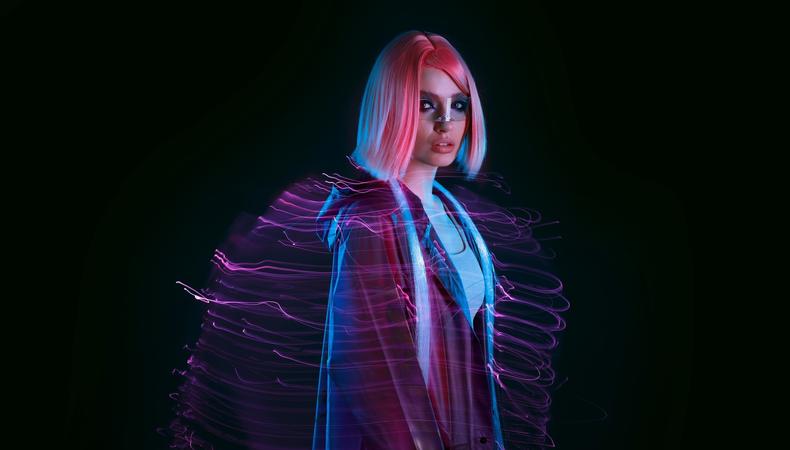
What do Shudu, Lil Miquela, and Aitana Lopez have in common? They’ve all worked with big fashion brands, they each have huge social media followings, and…they’re all virtual models.
In the not-so-distant past, virtual models and AI fashion models felt like internet art novelties. Shudu, “the world’s first digital supermodel,” and Lil Miquela, a CGI performer who’s been on the scene since 2016, now join the ranks with an increasing number of AI influencers, like Aitana Lopez.
Using generative AI is becoming industry practice. Models are now being asked to sit for scans and create a digital version of themselves as part of the job. Here’s a look at what that means for anyone hoping to get scouted or become a model.
JUMP TO
AI fashion models or virtual models are three-dimensional computer-generated images that look and pose like real models. There are two main types.
- Digital humans: These are entirely fictional CGI creations with an invented persona, such as Shudu and Miquela. There is no single real human behind the face (although they are usually composites of real images). They’re built and owned entirely by a studio or brand.
- Digital twins: A digital twin is a realistic AI replica of a specific, consenting model, built from thousands of photographs or scans of that person. The twin can be dressed, posed, and placed anywhere without the model attending a shoot. Crucially, it still depends on a real person’s likeness, and the model, in theory, keeps their rights and gets paid.
Both are used for e-commerce, social content, and fast-turnaround marketing, in which production speed and quantity of images are the priority.
AI models are no longer a fringe experiment, as many brands – notably H&M and Zalando – are using them.
H&M announced in 2025 that it would build digital twins of 30 real models with tech firm Uncut. Each model would retain rights and be paid when their twin works, just like on any campaign production. Chief creative officer Jörgen Andersson said in a statement that using AI-generated models was to “amplify creativity and reimagine how we showcase fashion…to enhance storytelling and find new ways to connect with our customers.” Model Vanessa Moody, whose twin featured early on, called it “professional, collaborative, and transparent.”
Zalando has gone further, disclosing that roughly 70% of its imagery in late 2024 was AI-produced, built with studio Orendt. The retailer says digital twins cut production costs by around 90% and shrink turnaround from nearly two months to a few days. Model Marylou Moll, who was involved in the scheme, said it let her “expand my scope of work and take part in multiple photo shoots at the same time.”
Generative AI can create photo-realistic images in a matter of seconds and for a fraction of the cost of a shoot production. Marketing demands new content all the time, so it feels like an inevitable move for most brands – especially fast fashion.
Models are aware of the risk AI poses to their livelihood. In 2020, Sinead Bovell wrote an article for Vogue titled “I Am a Model and I Know That Artificial Intelligence Will Take My Job.”
Some areas of modelling are more at risk than others.
Up top is the repetitive, high-volume, low-narrative commercial work. E-commerce product shots, routine social content, and formulaic marketing assets are exactly what AI-generated models are perfect for. If a brand needs one model in 200 products across 20 markets in 24 hours, the case for AI is hard to argue with. That means that entry-level and midtier marketing work is shrinking fast.
The most resilient areas for modelling work are anything built on presence, spontaneity, or lived experience. Think runway shows in which a model’s walk and energy is required. Another area is high-concept campaign work, particularly that which is fronted by a known face, and experience-led work such as fittings or brand experiences.
AI fashion models are technically capable and cost-efficient. But for a brand that wants to create a genuine connection with an audience, they fall short.
In 2021, Beauty critic Jessica DeFino coined the term “meta face” to describe the new beauty standard created by virtual models. It refers to the ultra-smooth, ageless, and perfectly symmetrical look that is characteristic of digital humans. The consequences of this new look could be harmful. “Research has shown that constantly seeing photoshopped, airbrushed, and digitally altered human models has devastating effects on mental health,” DeFino told i-D in 2022.
Real models provide not only an authentic look, but also a genuine personality and background. Completely virtual models are created by people who identify differently from how the model looks, which raises the issue of authenticity and exploitation. Shudu, a dark-skinned, female-identifying Black woman, was created by Cameron James Wilson, a white British man. Although Wilson claims Shudu was created in close collaboration with real Black models, such as Misty Bailey, it doesn’t take away from the fact that he is profiting from a diversity that is not his own.
When H&M’s plans emerged, branding consultant Andrew Dobbie noted digital replicas struggle to capture “the intangible moments” that occur spontaneously on a shoot. Instinct in front of a camera, the ability to interpret direction emotionally, the unplanned imperfect moment that makes an image feel alive, and genuine camaraderie with a crew are all essential human touches that only real models can provide.