
If you’ve ever watched a blockbuster movie or binged on the latest hit show, you’ve seen CGI in action. From towering dragons to shimmering holograms to fully digital worlds, CGI has become one of the most powerful tools in modern filmmaking.
But what exactly is CGI? How does it work? And how do you act convincingly alongside things that aren’t really there?
In this feature, we’ll explain what CGI is, show how it’s used in television and film, and share practical tips for actors navigating scenes with computer generated elements. Whether you’re just starting out or building experience, understanding CGI can give you an edge when it comes to getting cast for acting jobs.
JUMP TO
CGI stands for “computer-generated imagery” – visual effects (VFX) that are created digitally rather than captured through traditional cameras.
It isn’t the same as animation. Although animated movies are fully computer generated from start to finish (like Toy Story, which was the first fully computer-animated feature film), CGI is also woven into live-action productions to extend sets, create creatures, enhance environments, or bring fantastical elements to life.
The technology has roots in the 1960s, but 1993’s Jurassic Park is widely regarded as a revolutionising moment for CGI in film.
In everyday filmmaking, you’ll see CGI used to:
- Add digital characters or creatures
- Enhance or replace backgrounds and landscapes
- Create explosions, weather, or other effects that are dangerous or impossible to shoot
- Blend physical and digital elements seamlessly
Movies like Avatar and The Avengers rely heavily on CGI, but television – from fantasy epics like The Witcher to sci-fi dramas like Stranger Things – also increasingly uses it extensively. In each case, CGI helps expand the world beyond what a camera and physical props could capture.
CGI plays an increasingly important role in the Australian film and television industry, helping local productions compete on a global stage and attracting major international projects. Australian studios and VFX houses are widely recognised for their technical and creative expertise with CGI, contributing to both homegrown hits and some of Hollywood’s biggest franchises.
Australia’s leading VFX studios are Rising Sun Pictures, Luma Pictures, Animal Logic, and Framestore Melbourne (originally operating as Iloura, before the studio was acquired by Method Studios and then Framestore).
Animal Logic’s broad portfolio includes designing visual effects for The Matrix (1999), including the iconic computer code, and developing Australia’s first completely digitally animated feature, 2006’s Happy Feet (produced and directed by George Miller, of Mad Max and Babe fame). Happy Feet set a new benchmark for fully animated features, blending motion capture and expressive digital character work.
Luma Pictures is a globally renowned visual effects studio with a location in south Melbourne, where the team works on some of Hollywood’s biggest blockbusters, from the delightful rock-based alien voiced by Taika Waititi in Thor: Ragnarok (2017) to the Molten Man in Spiderman: Far from Home (2019) and the “invisible CGI” of Baz Luhrmann’s Elvis (2022).
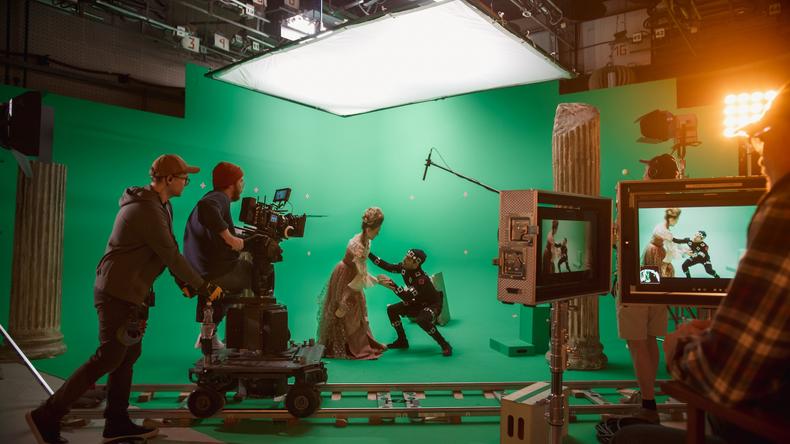
Although much of what audiences see on screen is digitally enhanced, these films rely on real performances captured on Australian soundstages – often surrounded by green screens, tracking markers, and partial sets.
What that means for Australian actors is that working with CGI is no longer the exception. From fantasy and sci-fi to family films and action blockbusters, digital effects are now embedded in the everyday reality of local screen production.
Gorodenkoff/Shutterstock
Regardless of whether you want to work primarily as a digital artist, having a broad understanding of how CGI works can be helpful. At its core, CGI involves three major stages.
1. Preproduction and planning
Before filming begins, directors and visual effects supervisors plan how and where CGI will be used. Storyboards and concept art help map out scenes that require digital effects. This stage often determines whether an actor will interact with a prop, a performer in a suit, or thin air.
2. On set: filming the live action
When actors are on set, many CGI elements are not yet present. This is where the magic (and the challenge) really begins. To help actors and the camera team capture the right movement and perspective:
- Stand-ins or motion reference actors might portray CGI creatures in basic costumes or with tracking markers.
- Props and placeholders (such as foam swords, balls on sticks, or green-screen objects) give physical references.
- Green screens may surround actors so CGI backgrounds can be added later.
If you’re meant to be talking to a digital alien, for instance, you may be looking at a stick with a tennis ball on top. The visual effects team later replaces that stick and ball with the finished creature during postproduction.
3. Postproduction: CGI integration
Once filming ends, the footage goes to the VFX team. Artists build 3D models, animate them, and integrate them seamlessly into the live-action shots. Lighting, shadows, and physical interaction are all fine-tuned so the final frame looks as real as possible.
The result you see onscreen – animals, creatures, explosions, futuristic cities – is the product of countless hours of digital artistry layered on top of performances by real actors.
You might be wondering: Why should I, as an actor, care about computer-generated imagery?
It’s simple: CGI is everywhere in contemporary TV and film, and CGI isn’t just for blockbusters. You may assume CGI is only for big-budget projects, but it’s also common in TV series, commercials, and streaming projects of all sizes.
Even shows with modest budgets use computer-generated imagery to do things like enhance set extensions, remove unwanted elements, and add atmospheric effects such as fire, smoke, and rain.
That means actors at all levels are likely to encounter CGI at some point – whether you’re auditioning for an indie sci-fi pilot or a blockbuster-scale franchise. As casting opportunities increase for projects that use CGI, actors who know how to work with these tools stand out.
Here’s what CGI means for your performance:
- You may be interacting with nothing but air during a scene.
- You’ll often have to imagine the presence of a character or creature that doesn’t exist yet.
- Timing, eyelines, and physical responses need to be precise without traditional references.
It can feel awkward at first, but, with preparation and imagination, you can deliver authentic performances that hold up even when a digital dragon or an imaginary view is added in later.
Here are practical, actor-focused tips to help you thrive in CGI-heavy environments.
1. Focus on the eyeline.
When there’s no real person or creature, the director or VFX supervisor will usually indicate where the digital element will be. Keep your eyeline steady and natural. Rather than looking at where a tennis ball is, imagine where your scene partner should be.
2. Treat stand-ins like real actors.
If another performer is doubling as a stand-in (in a motion-capture suit, for example), engage with them as you would any actor. Their movements help you and the camera capture the right energy, and your reactions will be more believable.
3. Understand the scene’s intention.
Ask questions during rehearsal: What is this creature doing? How big is it? What’s its energy? The more specific the mental picture you create, the more grounded your performance will feel once CGI is added.
4. Stay present and responsive.
It’s easy to zone out when you’re staring at an empty space – especially if you’re expected to do so for a long time – but acting is about reacting. Even if something isn’t truly there, react to it as if it is through your emotion, physicality, and intention.
5. Learn some VFX vocabulary.
Knowing basic terms, such as motion capture, green screen, tracking markers, and postproduction, helps you communicate confidently with directors and crew. It also shows professionalism and curiosity about the craft.
Understanding CGI in movies isn’t optional for today’s actors – it’s part of the job. From knowing what CGI stands for to mastering how to interact with invisible elements on set, embracing CGI empowers you to deliver stronger, more believable performances.
The more comfortable you are with the technology behind the magic, the more versatile and employable you’ll become. So go ahead and dive into the world where physical performance meets digital wizardry.