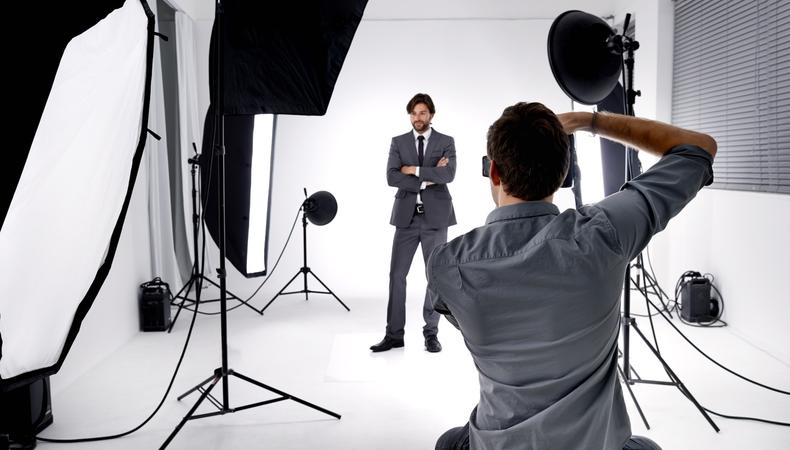
From Mario Testino and Kate Moss to Jean-Paul Goude and Kim Kardashian, a well-chosen modelling photographer partnership can create powerful, impactful images.
As a model at the beginning of your career, the quality of your portfolio hinges on one crucial decision: the person who captures your photos. So you’re probably wondering how to find a good photographer.
Building a strong model portfolio will help to shape first impressions with agencies, casting directors, and clients.
You may find callouts from modelling photographers for models at open castings, but you can also handpick a photographer who is the right fit for you. Use the checklist below to help you source the model portfolio photographer who’s best for you.
JUMP TO
Before you get in touch with any photographers, you need to work out what type of model you are – or want to be. Are you aiming for fashion and editorial work? Or are you more interested in commercial modelling? Other niches to consider include beauty and fitness. A moody editorial shoot is very different from a brightly lit product-focused catalogue image, and photographers specialise in different areas and styles.
Working that out first will help you decide on the best model portfolio photographer for you and your modelling career.
Pull a few reference images that match your goals and look for common themes. Do they use natural light or were they shot in a studio? Is there minimal retouching or do they show highly polished beauty? Are the shots full of movement or more classic? Are they in colour or black and white?
The mood board should guide your photographer shortlist (step five) and help you communicate clearly to them what you want.
You can use a mix of sources to work out how to choose a photographer for your modelling portfolio. First, check agency credits by browsing agency social media pages. Not all agencies share that information, but some – especially smaller, regional agencies – do. If an agency consistently works with someone, that’s a sign they’re reliable.
You can also find photographer credits in magazines – especially the editorial shoots. Bear in mind that photographers for the most famous magazines, such as Vogue and Harper’s Bazaar, will be more expensive and harder to book.
You can also ask makeup artists, stylists and other models for recommendations.
Make a list of five to eight professional photographers whose work aligns with the style of shoot you hope to book. Evaluate the portfolios they’ve shot with a critical eye. (Make sure you visit the photographer’s website, not just their social media pages, since a curated portfolio shows consistency, whereas a feed on social media can be misleading.)
Look for range and consistency within their style. Can they shoot full-length, three-quarter, and tight crops? Do they have a range of model sizes and skin tones in their portfolio? A decent photographer can make anyone look great. Be cautious if the portfolio shines with only one muse.
Rates vary by location and experience, but in the UK you’ll typically encounter TFP, half-day or full-day fees, or per-image packages.
TFP (time for print or trade for print) are collaborative shoots that provide both the photographer and model with images for their portfolio, with no fee exchanged. TFP shoots can be great early on, but you should clarify usage (how and where the images can be used), the number of final edits, and timelines before you commit.
With half-day and full-day fees, you should expect to pay a creative fee plus add-ons. Before you commit, ask what’s included, such as preproduction, studio hire, lighting kit, assistant, retouching, file delivery, and VAT.
Some photographers offer per-image packages that have a lower shoot fee and a predetermined number of retouched finals. Make sure to ask about the cost of additional edits.
More expensive isn’t always better. The best value is the photographer whose style matches your goal, which will lead to less retouching and fewer reshoots.
In the UK, copyright typically belongs to the photographer unless explicitly assigned. You’ll usually receive a license to use the images for self-promotion, such as for your portfolio, social media, and agency submissions.
Signing a legal document, known as a model release, is standard for tests and portfolio work, and it ensures that you both can use images for agreed purposes.
Under-18s will require a photographer who has proof of an up-to-date DBS check, and a parent or guardian should be present at the shoot.
It’s worth getting everything in writing with a simple contract or email summary. It should cover fees, usage, number of edits, delivery timelines, cancellations, and any rescheduling arrangements.
Depending on the kind of shoot you are planning, you may need a team to help bring your images to life.
A simple, natural shoot generally requires only yourself and the photographer, but it’s still worth bringing a few outfit changes and a bit of natural makeup. For something more creative, such as an editorial or beauty shoot, you will need a cohesive team, including a makeup artist, hair stylist, and wardrobe stylist.
Photographers often have people they can recommend, but you can also do research and suggest people if you have a particular look in mind or have been recommended someone.
It’s easy for an inexperienced model to be exploited by unprofessional photographers. There are a few red flags you should keep your eye out for. If your photographer is pushing for oversexualised images, walk away (unless you are hoping to get into glamour modelling). Never feel pressure to say yes to anything you are not comfortable with.
Your photographer should communicate clearly and be willing to answer all your questions. If they are being vague about pricing, pressuring you to shoot without a contract, or unwilling to discuss usage rights, then consider striking them off your list and looking for someone else.