
Being a content creator can be a great gig, but it takes time and energy to create and post all that content.
A hack, therefore, is repurposing your content across several different social media platforms. Some ways to do that include:
- Recycling: Rebuilding one piece of content into several, such as creating several YouTube Shorts from one long-form video, which differs from user-generated content (UGC) made by other viewers.
- Cross-posting: Posting near-identical content across multiple social media platforms, such as those same YouTube Shorts across Instagram, TikTok, and Facebook.
Understanding what we mean by “content repurposing” is vital, whether you’re starting your own channel or applying for paid content jobs.
JUMP TO
We’ll start with what Bundle.Social’s Marcel Czuryszkiewicz calls your “cornerstone content.”
“Once you have your cornerstone, everything else flows from it,” Czuryszkiewicz writes. “You’re breaking it down into smaller, platform-specific pieces.”
Check out how it’s done by one of the UK’s most popular content creators, Colin Furze. Long-form YouTube videos are Furze’s cornerstone content, partly because longer content breaks down easily into smaller content repurposing ideas and partly because it’s his main focus.
We’ll use his video The Magnet Suspension Skateboard as our main example.
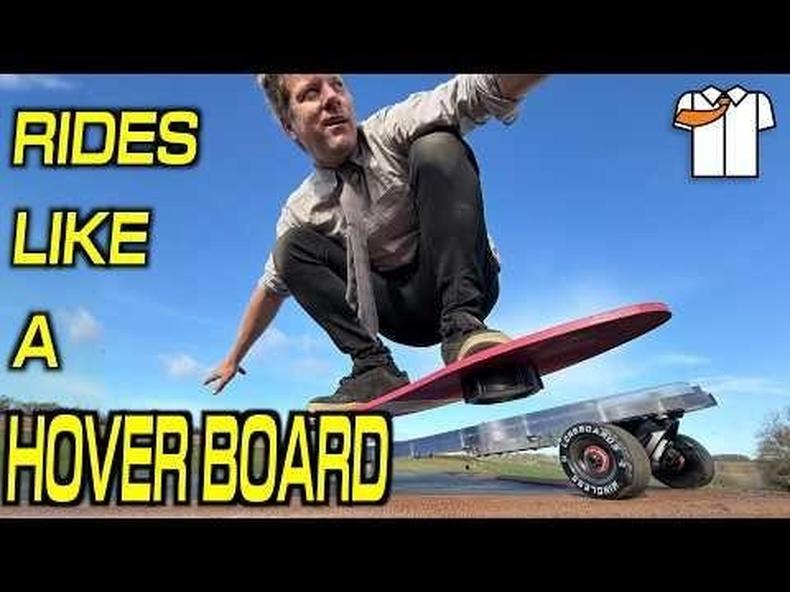
That YouTube increasingly values long-form content is something Furze understands. “If you think back to when I started, you were always trying to get a video to be like two or three minutes long – short, snappy, grab the attention,” Furze said in an interview with Benedict Fowler. “Whereas now, they try pushing for longer-form stuff.”
His hoverboard ticks that box with a 22-minute runtime.
The video also includes other features.
An engaging title and thumbnail
“You know how algorithms work and how people’s attention spans work,” Furze says. “A great title and a great thumbnail…that’s the first job over with the video.”
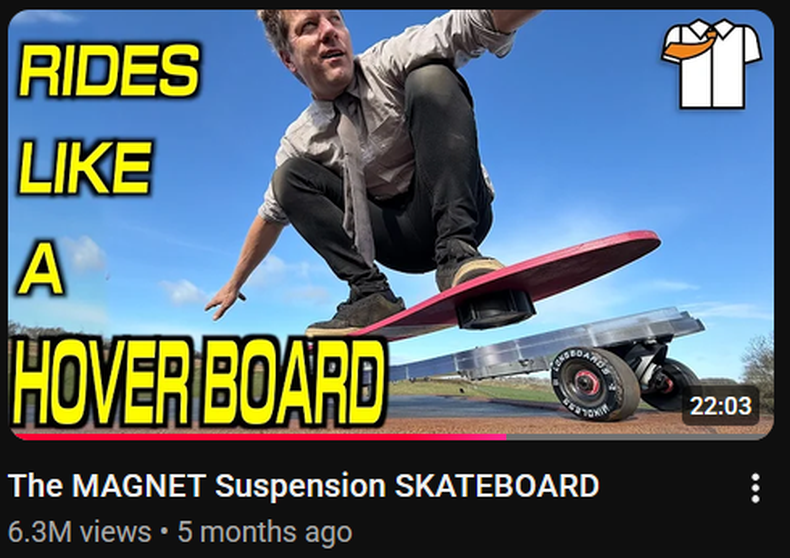
Both elements work together.
The thumbnail’s intriguing imagery pulls you in, yellow text pops against the background to increase interest, and the “safety tie” logo marks it as his. The snappy title then gives added context, hinting at how it works while making the video easily searchable.
A full description
“YouTube video descriptions can be up to 5,000 characters,” Brent Barnhart writes for Sprout Social. “That gives you a lot of real estate to work with when it comes to opportunities to optimize your videos and engage viewers.”
Furze takes advantage with a lengthy 1,600-character description that covers everything from social links to the expert-recommended three to five hashtags.
Tight editing
The first 30 seconds cover what he’s going to do and why he’s going to do it, and it offers a sneak peek at how it all comes together. From there, you’ll notice the entire video is nicely broken up with B-roll close-up shots and multiple cuts to different camera angles.
Furze still shoots and edits everything himself, so don’t assume you need a professional crew or the finest content creator equipment.
A closing CTA and clickables
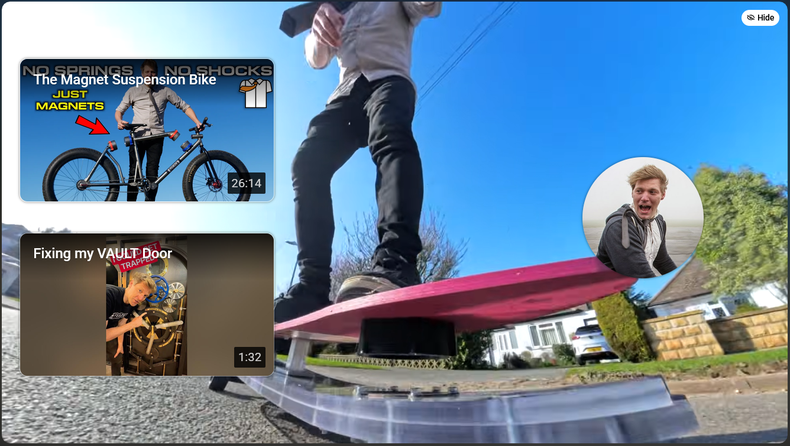
Furze closes by asking for ideas in the comments to improve his design. He also gives a quick update on the next video and asks viewers to subscribe for more awesome projects. Then the final few seconds create an end screen with clickable links to his channel and two other videos.
Using content-repurposing tools to turn long-form YouTube content into Shorts helps reach wider audiences and drive traffic back to the original video.
Research shows channels posting no Shorts see below-average views on their long-form content, while those posting a handful a month do roughly 50% better than average.
Furze was an early adopter, releasing his first Short in November 2021, just a few months after they launched.
He’s made two from the hoverboard video:


Each video:
- Stands on its own: A little footage not included in the original video helps create content that hints at more while still telling the whole (albeit very abridged) story.
- Holds your attention: The first seconds feature novel, interesting visuals to prevent people scrolling ahead, and several of the original’s most captivating moments are quickly edited together to hold that attention.
- Features a call to action: In the first video, Furze tells us to “follow for more epic inventions” and captions “full video on my channel” at the end. The latter video closes with a caption asking viewers to “follow for more inventions.” Both also have a clear, clickable link to the main video.
- Is well cropped: As Furze does here, all video should be cropped to a 9:16 vertical aspect ratio for short-form content, including TikTok and Instagram Reels.
- Has a concise title and description: The Shorts algorithm values relevant hashtags and clear keywords. Titles and descriptions are tight with a single CTA pushing you to the full video.

Furze repurposed those two YouTube shorts on TikTok under the captions: “And it works so well #colinfurze #backtothefuture #hoverboard #engineering” and “Like Surfin on Air #colinfurze #backtothefuture #hoverboard #engineering #magnets.”
Plus a fresh one: “Now this is a project. #colinfurze #backtothefuture #hoverboard #engineering.”
Even when content is the same, Furze uses the platform-specific captions tool rather than reposting what he used for YouTube Shorts, which could have meant a policy violation.
He also responds to TikTok’s best practices by putting hashtags right in the title and keeping the title very short and casual.
And why might he have done three shorts rather than two? Because TikTok values high posting frequency and content tends to get the most views within the first day or two, while the views on YouTube come in more steadily.
Timing also factors into Furze’s content-repurposing strategy.
That additional TikTok is released the same day as the original video to drive traffic over, whereas the first Short comes a few days later to avoid promoting something that just came out on the same platform.
Since TikTok’s algorithm tends to work well for new creators without an established following, these tips should prove particularly important at the start of your content-creation career.
Those same three short-form videos are also posted as Instagram Reels, but under different captions:
- “A REAL HOVERBOARD?????”
- “THE FUTURE……this is the colinfurze Magnetic Suspension Board”
- “Feels like your surfin on air”
Much of what worked on TikTok carries over: the timing, editing, use of hashtags, and frequency work here too.
But there are some differences. “TikTok engagement is broad but shallow,” Christian writes for CreatorFlow. “A viewer might watch your 15-second clip, double-tap, and scroll on. Instagram engagement tends to be deeper. Comments are longer, DMs are more personal.”
That may be why Furze poses a question rather than makes a statement on Instagram:

As opposed to TikTok:

“Instagram users write captions to add context, tell deeper stories, and connect with their followers, [while] TikTokers use their captions for search engine optimization,” Carole Foy writes for Twicsy. “[They’re] typically extremely short.”
Note the difference in Furze’s title for the same video on Instagram:

And then on TikTok:
Facebook is a different matter entirely. “Its limitations are obvious,” Carlos Pacheco writes for the Canada Media Fund. “You only see videos that appear at the top of your newsfeed. Once the hype dies down, they are lost in Facebook’s black hole of content. It’s very difficult to search and find videos posted in the past.”
Furze compensates by posting the same videos multiple times across several months:
That may look spammy on an Instagram, TikTok, or YouTube Shorts page, but it’s not as obvious on a platform where content disappears down timelines so quickly and generally gets most views within the first 48 to 72 hours.
But maybe the biggest difference is that Furze adds two longer videos, each only marginally chopped down from the original 22-minute YouTube video. You get a seven-minute video on 24 April and 7 June and a nine-minute video on 21 June and 10 August.
Those videos may feel out of place on Instagram and TikTok (or simply redundant on YouTube), but they fit well on Facebook.
Why? Because Facebook hits a more mature audience. “YouTube and TikTok dominate the 18-to-24 demographic, while Facebook remains the most effective platform for reaching UK consumers aged 45 and above,” Jacqueline Zote writes for Sprout Social.
Furze ensures that his content is new for Facebook, but he also takes the opportunity to hit older viewers not active on other platforms with a long-form video that covers far more of his process than shorts posted to TikTok, YouTube Shorts, and Instagram.