Writing an actor bio won’t be the most exhilarating part of your early acting career, but it’s one no performer can escape. Crafting the perfect casting profile? You’ll need an actor biography. Starring in a play? An actor bio will be required for the programme. Updating your IMDB page? It’ll feature there too.
But it needn’t be a chore! Writing your actor bio is an opportunity, and a golden one at that. “It’s your chance to share who you are, what drives you, and why people should be excited to work with you,” writes arts and entertainment PR expert Diane Foy. “Done well, it can help you stand out in auditions, connect with casting directors, and attract superfans to your work.”
A powerful tool indeed, so let’s discover how to write an actor bio.
JUMP TO
Firstly, here’s what an actor bio isn’t:
- An acting CV. A CV is a one- or two-page document for listing all your credits and qualifications.
- An acting cover letter. These serve as introductory notes for applications to talent agencies and casting managers.
Instead, consider the actor bio your elevator pitch: a several-line insight into the most important elements of your career, plus a tiny morsel or two about who you are as a person.
Strong actor bios can achieve the following in just a few short sentences:
- Position you in the market by signalling your casting type and range.
- Build trust by showcasing your notable roles.
- Help any decision-makers seeking professional actors remember who you are.
1. Full name
Your full name should feature, but there’s no need for your phone number and definitely no need for a URL to your socials or website in your bio. Your name should already be more than sufficient for anyone interested in finding you online.
Good actor bio example:
“James Hollywood is currently starring as…”
Bad actor bio example:
“James Hollywood – jameshollywood.com. 07777 777 777. Based in London. Currently starring as…”
2. Current role (for a strong start)
Kick off with a win by mentioning what you’re currently working on – if it’s among your biggest projects – rather than some incidental background details. If you’re between jobs or you’re working on something significantly smaller than your largest credits, go for your latest role that matches the upper echelons of your career.
Good example:
“Currently starring as Orlando in As You Like It, in his second role with the Royal Shakespeare Company.”
Bad example:
“Passionate about acting, James was born in Reading and moved to London in 2020 after university.”
3. Career highlights
Your CV should include a full list of credits, but your bio should curate a few career highlights into a narrative.
Good example:
“Hollywood has gone from delivering babies as a regular in Call the Midwife to beefing with Montagues as Tybalt in Romeo and Juliet with The Lord Chamberlain’s Men touring company.”
Bad example:
Previous credits include Eastenders, Romeo and Juliet, Under Salt Marsh, Bridget Jones: Mad About the Boy, Call the Midwife, The Curious Incident of the Dog in the Night-Time, Coronation Street, and Doctor Who.
4. Training
Just a line or two covering your training as an actor, plus anything else relevant to your career. Think stage combat classes or accents, rather than skills that don’t necessarily translate to your career. If you’re crafting an actor bio with no experience, make this your focus.
Good example:
“James studied theatre at the Liverpool Institute for Performing Arts (LIPA) and trained in MOCAP performance with LAMDA.”
Bad example:
“Took A-level drama followed by theatre in Liverpool. Also trained in MOCAP performance and open-water diving.”
5. Human touch
Personal experiences and special skills can close out bios with a dash of personality and humour. You’ve already covered the important stuff – now humanise yourself without going overboard.
Good example:
“When not acting, James is found running marathons (slowly), playing badminton (poorly), and raising his two sons (thanklessly).”
Bad example:
“James enjoys running, sports, and spending time with his family.”
Remember that no actor bio is set in stone. Yours should change alongside your career to ensure that it’s always giving an accurate snapshot of your current situation. Don’t recycle old bios for new programmes or forget to regularly update your online casting profiles.
The watchwords here are “punchy” and “concise.” StageMilk recommends “maybe 200 words,” while Casting Networks says most website bios come in between 150 and 300 words. Theaterish, meanwhile, suggests getting it down to 40 to 100 words.
“Write your bio like it’s an old-fashioned telegram,” actor Jack Crumlin writes for StageMilk. “Each word costs you a dollar.”
In a nutshell: Keep it minimal. Remember: This is a taste of your career rather than a full rundown. Think mouthful rather than meal.
There’s no firm consensus on this. Some say first person (“I”). Others swear by third (“she”/“he”/“they”).
General rule of thumb:
- First person is more personal and suited to social media bios and personal websites.
- Third person is more professional, typically appearing in programmes and professional directories.
If in doubt, check other bios from the same source you’re submitting to and follow their lead.
“Just make sure you commit one way or the other,” Crumlin writes. “Don’t swap halfway through.”
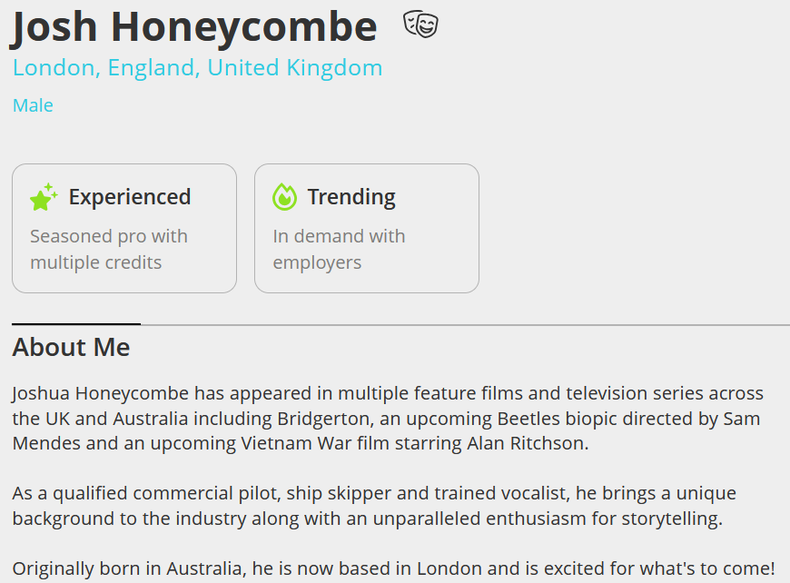
Actor bios are invariably found in digital casting profiles.
You’ll find actor’s bio samples filling each profile’s About Me section, such as this one from London-based Josh Honeycombe.
Other places you may find an actor bio include:
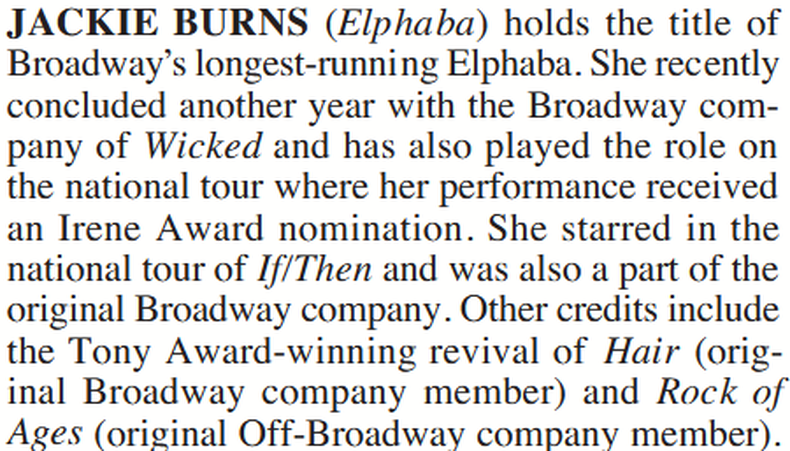
- Theatre programmes (or “playbills” in the US): These are generally on the shorter side with an emphasis on the current role and similar previous productions. Here’s a sample from an LA-based production of Wicked.
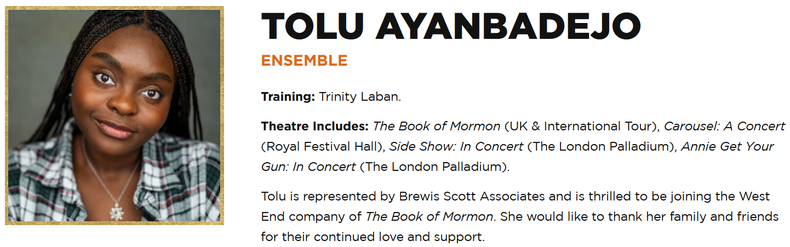
- Production website: These are similarly concise as actor bios in a programme, as in Tolu Ayanbadejo’s online bio from the latest West End production of The Book of Mormon.
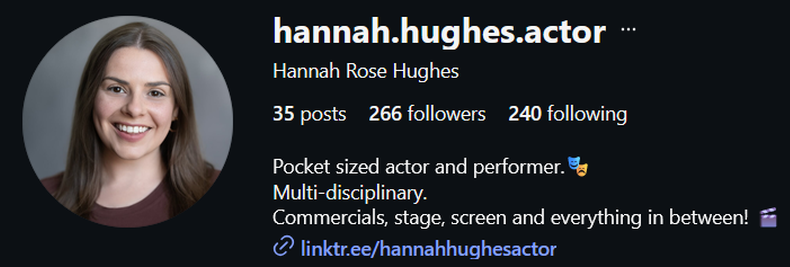
- Social media: A short and sweet header for the top of your profile, typically written in the first person, with a greater emphasis on personality than professionalism. For example, London-based actor Hannah Hughes’ Instagram bio.
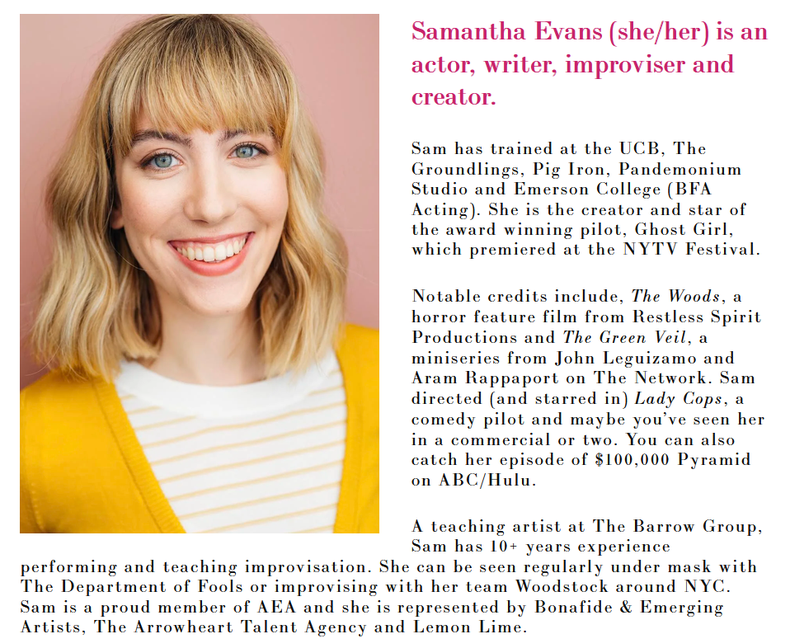
- Personal website: Typically a little longer and more personal – it’s your website, after all. Actor Samantha Evans plants her actor website bio right on the homepage.