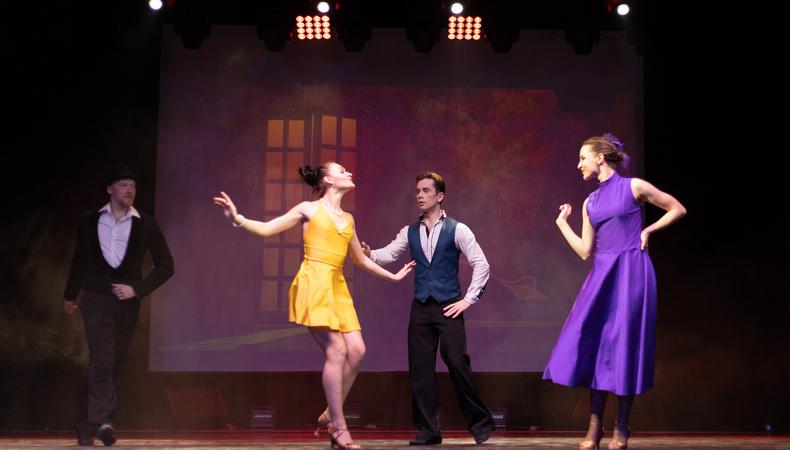
In many acting styles, the script is front and centre. But in physical theatre, your body is your primary instrument you use to convey character and tell stories.
This approach is as old as the art form itself, from the highly stylised choruses of Ancient Greece to the exaggerated gestures of commedia dell’arte in the Middle Ages. The tradition continues to this day, thanks to modern practitioners like Steven Berkoff, Kathryn Hunter, and Julie Taymor.
For actors, studying physical theatre can broaden your range and open up more opportunities, all while deepening your ability to connect with audiences and fully inhabit characters.
Here, we break down what physical theatre is, why it’s worth exploring, and how you can bring it into your own practice.
JUMP TO
Traditional theatre relies on directors—and, sometimes, choreographers—to help actors bring the script to life onstage; and even relatively static productions require performers to be aware of their bodies. So what distinguishes physical theatre from other styles?
Movement is at the core of the technique. French practitioner Jacques Lecoq, one of the founding fathers of physical theatre, based his approach “on the idea that the body is the actor’s primary tool for expression.”
Physical theatre productions aren’t necessarily dialogue-free, but they do prioritise movement over text. They’re typically highly stylised and choreographed, incorporating techniques such as mime and abstract dance. Whereas actors who employ a more naturalistic approach (such as the Stanislavsky technique) approach characters from a place of emotional realism, a physical theatre performer translates those feelings into exaggerated gestures or interpretive dances.
Some productions involve little or no dialogue, as seen in the work of London’s recently shuttered DV8. Others weave physicality around the text or break up dialogue with extended movement sequences; for an example, check out Frantic Assembly’s 2015 Othello. In some productions, a director may instruct their cast to incorporate the exaggerated gestures of physical theatre into an otherwise naturalistic production.
Connecting with the audience
Practitioners often stress the strong emotional bond the form forges between performers and viewers. “We wanted to arrest our audience’s imagination, awaken their senses, and fill them with energy and vitality,” said Amit Lahav, the artistic director and founder of Ipswich company Gecko.
“I love the connection the work can find with its audience,” Scott Graham, the artistic director of Frantic Assembly, explained. “We get a very young audience, and the energy and reaction is extraordinary.”
The highly stylised movements and unpredictability of physical theatre can create an immersive experience; techniques such as mime require audiences to fill in what’s missing with their own imaginations. Physical theatre company Complicité even derived its name from the collaborative creative process between actor and audience.
Creating work that feels universal
Prioritising movement over speech means that any theatregoer can connect with a production, whether they speak English or Swahili. According to author Michael Fry, Complicité was greatly influenced by the experience of traveling to Chile for a production of A Minute Too Late in 1984. Performing for audiences who “spoke no English and had little education” perfectly suited the company’s movement-forward performance style.
Just think of Rowan Atkinson’s expressive Mr. Bean. Since the character communicates his feelings and dilemmas through facial expressions and movement rather than words, speakers of any language can enjoy his shows, which have aired in a whopping 190 countries.
Allowing for smaller casts
Adopting physical theatre conventions can help productions with small ensembles—or even a single person—bring a wide range of characters to life and ensure they’re instantly recognisable to audiences. In a recent production of his one-man show Jeeves Takes Charge, Sam Harrison used exaggerated gestures to evoke each of the many characters he took on, allowing him to flit among all 23 without confusing the audience.
Reinventing the classics
Physical theatre can breathe new life into well-known plays and stories. Consider PUSH Physical Theatre’s 2013 Arc of Ages. In a sequence based on the millennia-old Book of Job, the actor expressed the protagonist’s suffering by keeping a 60-pound steel wheel in motion throughout the scene.
PeopleImages.com - Yuri A/Shutterstock
It makes you a more versatile performer.
Adding the techniques of physical theatre to your toolkit will open up new opportunities for work and increase your value as a performer. If you’re familiar with styles like mime, gesture, and puppetry, you’ll be more appealing to directors looking to incorporate movement into their next production.
It deepens your understanding of character.
Physical theatre will give you tools to explore a character not only through what’s on the page, but by considering the way they move and hold themselves. Even in more naturalistic plays, this technique can add depth to your performance.
It improves physical awareness.
Ian McKellen once said that the “initial problem that an actor has to solve” is how to appear relaxed and natural onstage by “having control over every part of their body.” Physical theatre’s emphasis on movement can help you focus on how you move, increasing your physical awareness.
It helps you learn to avoid injuries.
Acting can be strenuous, especially onstage, and physical theatre training can help you understand how to execute big movements without risking injury.
Attend a course or workshop.
London’s Royal Central School of Speech and Drama’s eight-week Physical Theatre and Devising course offers a comprehensive overview of physical theatre and its techniques, as does Sydney studio the Actors Pulse’s eight-week Movement class.
If you don’t have the time or resources to take a longer class, you can learn the basics of the technique at a one- or two-day workshop. Here are a few places that offer courses in physical theatre.
UK
- Babel (London)
- Bristol Physical Theatre Project (Bristol)
- Facciocose (London)
- Moving Pieces Collective (London)
Australia
- Black Swan State Theatre Company (Perth)
- D.I.V.E. Theatre Collective (Sunshine Coast)
- Melbourne Physical Theatre School (Melbourne)
Do your research.
Reading about physical theatre may be less fun than performing it; but learning about the theory, techniques, and prominent practitioners will help you get a grasp on the practical side and teach you exercises to get you started.
Here are a few books to check out:
- The Moving Body: Teaching Creative Theatre by Jacques Lecoq
- Physical Theatres: A Critical Reader by Simon Murray
- Through the Body: A Practical Guide to Physical Theatre by Dymphna Callery
- Words on Mime by Étienne Decroux
Practice.
Online learning resource the Drama Teacher has put together a list of 50 physical theatre exercises. Some can be performed solo, while others should be done in collaboration with other actors. From improving bodily awareness to translating emotion into movement, each exercise offers a chance to practice physical theatre techniques.
See as many physical theatre productions as you can.
You can’t fully understand the form until you see it in action. Attending a play in person is ideal for experiencing the fundamental connection between actors and audience. Here are a few notable physical theatre companies:
UK and Ireland
- Belarus Free Theatre (London)
- Bruiser Theatre Company (Belfast)
- Complicité (London)
- Frantic Assembly (London)
- Gecko (Ipswich)
- Motionhouse (Leamington Spa)
- Punchdrunk (London)
- Spymonkey (Brighton and Hove)
Australia
- Legs on the Wall (Sydney)
- Stalker (Sydney)
- Zen Zen Zo (Brisbane)
It’s also worth researching companies in your area. You can also find performances online, including on YouTube (Frantic Assembly, Gecko, and BBC Teach’s homepages are good places to start) and National Theatre at Home.