Perhaps you’re looking to start a career as a professional dancer, but you’re not sure exactly which dance style is right for you. Or you may be a performer looking to widen your skill set. There are many acting jobs for which knowing how to dance may come in handy – think Bridgerton, in which the characters are constantly attending period balls.
For a career in musical theatre, it’s essential to know at least the basics of a few dance styles. And the more advanced you are, the more opportunities you can access.
Whether you want to live and breathe dance, you’re simply looking to broaden your skill set, or you’re pursuing a musical theatre career, it’s important to know some of the dance varieties that are out there.
Ballet
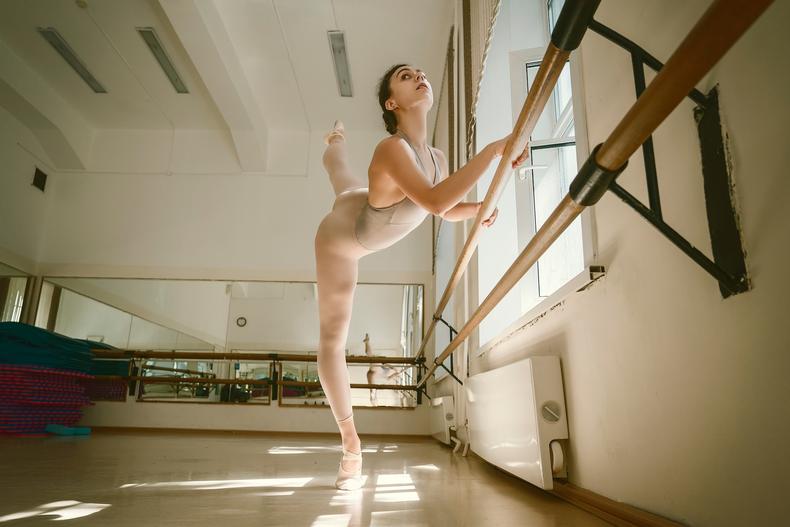
One of the most popular dance styles in the UK, ballet originated in France and Italy in the 15th and 16th centuries.
French King Louis XIV was a fan, and he founded the first ballet school in 1661, according to dance institution Sadler’s Wells. “The principles of the form remain much the same as they were then: the turned-out shape of the legs, the five positions of the feet and arms, the elegance and upright posture,” Lyndsey Winship writes for the institution’s website.
Winship adds that key moves include the arabesque (in which a dancer balances on one leg and extends the other behind them), a jeté (a jump that travels across the stage), and the pirouette (a spin on one leg).
It’s certainly not the be all and end all, but ballet is often considered the foundation for many other types of dance, such as contemporary and commercial. It is performed across the country in large theatres, opera houses, and dance venues, and there are many dance companies, including the Royal Ballet, Northern Ballet, and English National Ballet, dedicated to the form.
Credit: pacfoto/Shutterstock
Contemporary dance
Contemporary dance is about “fluidity, improvisation, and self-expression,” notes Rambert, Britain’s oldest contemporary dance company. The style emerged in the mid-20th century, “blending elements from ballet, modern dance, jazz, and beyond – but it refuses to be pinned down by any one of them.”
Contemporary means “of the now,” so it’s harder to pin down a definition of the constantly evolving style. According to Rambert, however, contemporary dance often refuses to be defined by rigid rules; it’s about emotional expression and connection to the music, and it often involves floor work. Other companies and venues dedicated to or showcasing contemporary dance include the Place and Sadler’s Wells, as well as training providers such as Northern School of Contemporary Dance.
Hip-hop
This style emerged in the Bronx borough of New York City in the 1970s. It has since become extremely popular, characterised by free expression and improvisation.
Initially “created by Black and Latino communities as a form of self-expression and storytelling,” the dance style sits within a whole hip-hop culture that also includes music, emceeing, deejaying, and graffiti.
Hip-hop dance can be either choreographed or freestyle, and it can include breakdancing moves, intricate footwork, and a lot of floor work.
The style is performed in lots of settings, including on the street, in parks, and at parties. Now it can be seen in music videos, in theatres, and at events like Breakin’ Convention at Sadler’s Wells, which describes itself as “the world’s biggest festival of hip-hop theatre.”
Ballroom dance
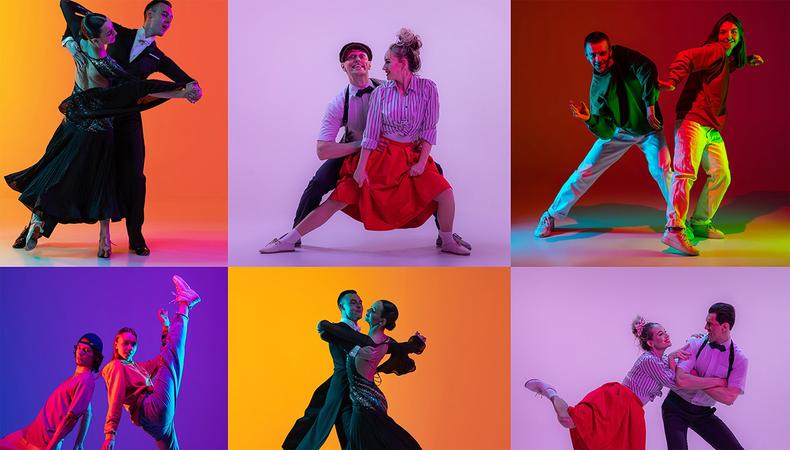
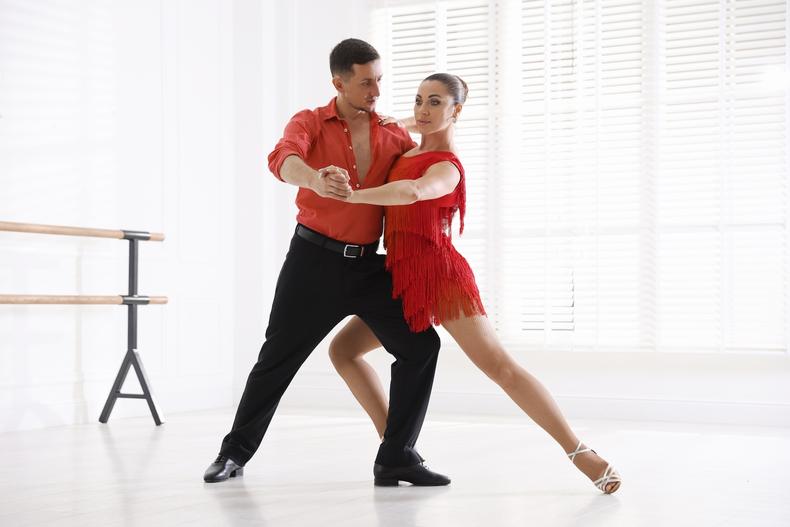
The waltz, tango, foxtrot, quickstep, cha-cha, rumba, and jive are all ballroom dances. The genre originated in royal courts in the 17th and 18th centuries, and by the 1900s, ballroom had become a competitive activity with contests springing up around the world. The art form was further transformed in 20th century Europe by Latin American and Caribbean influences.
It’s characterised by partner work, precise technique, and excellent posture, with dancers often dressing in formal evening wear.
Ballroom competitions are still widespread – the most famous in the UK is the televised Strictly Come Dancing – and the style is widely performed everywhere from community spaces to West End shows.
Credit: New Africa/Shutterstock
Tap and jazz dance
Although they’re two distinct dance varieties, tap and jazz have many similarities and are frequently blended into the same routines.
Tap and jazz were both “born in the African American community from a melting pot of African and European influences,” Winship writes. “The two became entangled in the early 20th century, flourishing in Prohibition-era speakeasies such as the famed Cotton Club in Harlem, where the light-footed Bill ‘Bojangles’ Robinson made his name.”
Tap dance is performed with special shoes that create rhythmic sounds as they hit the floor. It’s characterised by intricate footwork and requires a strong physical stance and sense of rhythm.
Jazz dance also uses a lot of syncopated rhythms and involves the isolation of different body parts while dancing, as well as expressiveness (think jazz hands!) and strong technique.
Both styles are frequently performed in traditional musical theatre.
Commercial dance
Commercial dance borrows and blends lots of styles, and it’s essentially “a broad term for choreography created for the entertainment industry,” according to Foundations Dance Collective.
This is the dance you’ll often see backing dancers do when big pop artists go on tour, or in music videos or commercials. The style is “often characterised by its flashy, high-energy moves and its use of props and costumes,” according to Adore Dance London. It often features choreography driven by trends, and it can include elements of contemporary dance, hip-hop, street dance, jazz, and heels.
Folk dance
Folk dance is a broad umbrella term for dances that originated from a specific region as part of that culture. It encompasses everything from flamenco, which originated in Argentina, to the harvest bhangra dance in India and Pakistan, to the Scottish and Irish ceilidh. Folk dance is often performed at community events and in social settings such as festivals and weddings.
This is by no means an exhaustive list. There are many more types of dance you may want to explore, but these are some of the core styles worth knowing about.
Once you’ve found the style that suits you best – and honed your steps – dust off your audition technique and apply for some open dance calls.