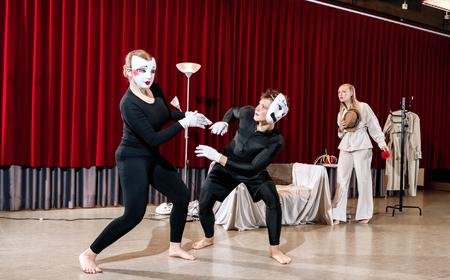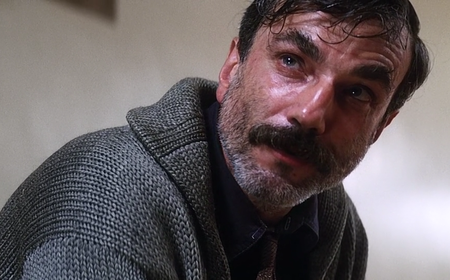
We all know overacting when we see it: a huge performance that feels so out-size and exaggerated it’s simply no longer believable. It’s a portrayal of a character that feels over the top, cartoonish, or broad if it’s a comic role; hammy, high-octane, and heightened if it’s a more earnest part; or mawkish, manipulative, and melodramatic if it’s in an emotionally intense role.
JUMP TO
There are many ways an actor can overdo a performance, from the technical to the emotional. Maybe they look physically awkward or ill at ease on stage, doing too many gestures or striding about distractingly. Maybe they begin a performance at a very high pitch of intensity; there’s nothing wrong with that in itself, but it can leave an actor with nowhere to go over the course of a film or play – no space for ratcheting up the pressure. Maybe they oversaturate every word and every line with despair or terror rather than charting a journey through it, which can flatten out emotionally powerful material. Maybe they fight too hard to make material funny or lines land powerfully (often, of course, having the opposite effect).
We all also want to watch actors who deliver memorable and potent performances, so how can actors learn the difference between giving a good performance that’s the right level of dramatic and shamelessly hamming it up?
It’s worth noting that the very concept of overacting has changed immensely over the history of theatre and film. A move toward naturalism – acting that allows us to suspend our disbelief and invest in characters as real – has developed in line with new technologies and changing venue sizes.
When all acting was in large, proscenium arch theatres, the actor’s job was to enunciate and emote hard enough to reach the back of the circle. Thespians performed in a grand, classical style that today seems stagey, heightened, and performative. (For a great example of this, watch Ronald Harwood’s The Dresser. Set in a playhouse during the Blitz, it follows a grand old actor, based on the real theatrical legend Sir Donald Wolfit, as he prepares to perform King Lear.)
Early films, too, demanded outsize performances. Without sound, gestures that to a modern eye seem absurdly grandiose were the order of the day. But between the development of first talkies and then TV, screen performances also began to get more intimate and restrained. As Norma Desmond famously said in Sunset Boulevard, “I am big. It’s the pictures that got small.”
The other thing that was shrinking was theatre size. Today an actor is just as likely to be a few steps away from their audience in a studio or black box theatre as they are to be on a lofty gilt-edged stage, so it is vital for an actor to be able to adapt the size of their performance to fit the space.
There are also times when giving an inflated performance may be entirely appropriate. Arguably, all clowning is about physical excess in service of humour. Certain work – such as restoration comedies or door-slamming farce – demands a mannered or heightened performance style. In comic roles, overacting can be the technique that’s used to drive laughter. Think, for example, of an actor like Jim Carrey, who has made a whole career out of his malleable, plasticine, but not-exactly-subtle facial expressions and physical slapstick comedy, especially in early roles like The Mask, Ace Ventura, and Dumb and Dumber.
In the theatre, certain directors may want a stylised, larger-than-life approach in a serious drama or tragedy. It may be about suiting a text: Consider, for instance, the moody aesthetic and turned-up-to-eleven high-stakes style of a director like Yaël Farber in directing tragedies. Or it may be about providing a new interpretation or read on a play – one that isn’t hide-bound by default naturalism. Consider the National Theatre’s 2026 production of Terence Rattigan’s Man and Boy, for which Ben Daniels has been hugely praised for his grandstanding in a villainous lead role. “Ben Daniels commands the limelight, steals every scene, and would chew the scenery if there were any,” critic Nick Curtis writes in the Evening Standard.
Onscreen, too, a judicious deployment of going absolutely over the top can prove cinematic gold. From Jack Nicholson’s mania in The Shining to Alan Rickman’s hammy Sheriff of Nottingham in Robin Hood: Prince of Thieves to basically everything Nicolas Cage has ever done, sometimes in Hollywood, more really is more.
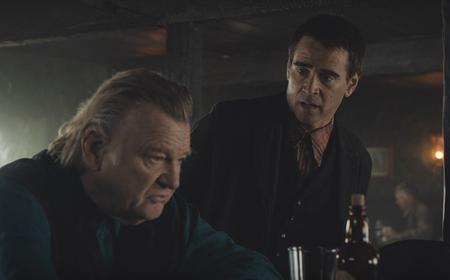
Let’s face it: Most actors starting out are not Jack Nicholson, and they’re not given leading roles in blockbuster films. It’s far more likely that you’ll have the best chance of getting that next job if you can turn in a subtle, nuanced performance rather than gnawing at the scenery. So can you avoid overegging the pudding?
1. Learn from the masters.
Over the 20th century, a range of acting theorists became increasingly concerned with how actors may deliver a more truthful performance – from Konstantin Stanislavsky to Sanford Meisner to Lee Strasberg. Explore their techniques, from Stanislavsky’s tips for character and script analysis to Meisner’s repetitive exercises for “behaving truthfully under imaginary circumstances” to the Method approach to inhabiting a role. Eventually, you’ll find which works for you – or you can cherry-pick different techniques from each.
2. Immerse yourself in film, theatre, and TV.
If you want to be a subtle, flexible actor, watch and learn from the greats. Get the fullest screen experience by watching films in the cinema, every nuance blown up in size for you to observe – and go to watch actors in the theatre, especially in venues where you can get up close and personal to observe the subtleties of how they act. Learn what kind of performances you think are well-pitched and which feel like examples of over- or underacting, and top up your knowledge by reading or watching interviews or master classes with those actors on how they approach a role. Read reviews to see if film, theatre, and TV critics agree. What sort of performances get criticised for being unconvincing, and why?
3. Practise doing less.
When you get a role, experiment by yourself (or, if appropriate, in rehearsals or with your co-stars) in how still, small, subtle, and contained you can make your physical performance, and how soft, quiet, or low you can make your vocal delivery. It isn’t likely to be your final take on a part, but, in paring back your performance, you may be surprised to find moments when doing less is much more powerful than really going for it.
4. Sit on your hands.
Metaphorically – but also maybe literally – if you can’t keep still, then sit on your hands! When we think about overacting, we’re often talking about actors who are being too physical: pawing at co-stars, stomping around a stage, gesticulating wildly. Such physical excess often reads like overcompensation – like an actor doesn’t trust the words or their ability to inhabit a role – and it can be distracting. Ensure that there’s an authentic impulse or clear objective behind each movement, and that it’s not just misdirected nervous energy.
5. Listen and react.
“Be in the moment. Period. Just be there. Because if you get all like, ‘Oh, I got to do this big thing,’ it just never works.” Sage advice from Robert de Niro, because good acting is less about demonstrating how a character is feeling to an audience or signposting what you are doing and more about being in the moment and being alive to the other people on stage. Rather than focusing on what you will do next in your performance, try to exist in the present and really listen to whomever you are interacting with onstage. A more instinctive response is likely to read more natural than a planned one.
6. Tape yourself.
Even when you feel like your performance is delicate and nuanced, it may still read as too much on camera or to an audience. To test it, tape yourself rehearsing the part and watch it back. The distance may help you notice any bad habits, physical tics, or moments when your vocal performance is coming across too forcefully.